
We spent the morning at a park in a seaside town called Casuarina, about ten minutes drive south, where our beautiful little granddaughter, Aurora, celebrated her 2nd birthday with a few friends. It was a lovely change to go out, and being in a large park we were all able to “social distance” successfully. Not that there’s any Covid in our area, but we cannot become complacent.
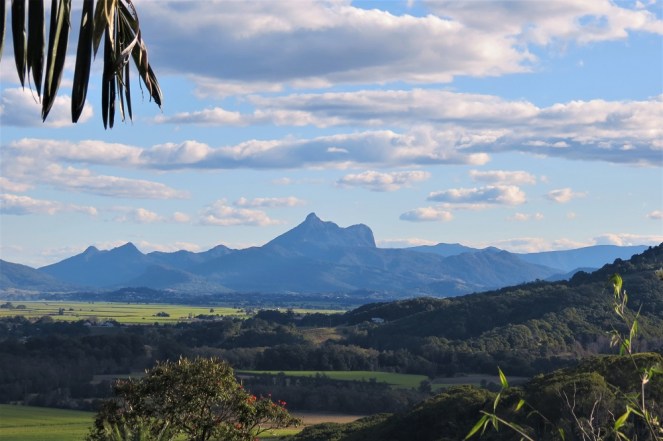
After the party, I asked my husband if we could stop off at a couple of different places so I could take photos of Mount Warning. I thought it would be a change from my usual back yard photos.
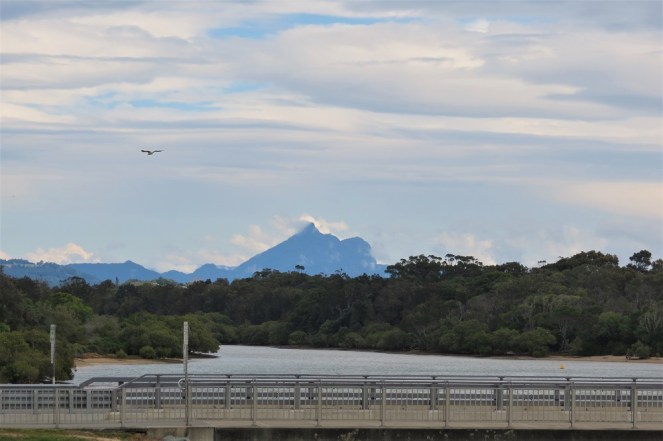
Our first stop was at Kingscliff. Rain was predicted this morning and thankfully it held off while the party was happening. There were masses of clouds lingering over the mountain though. My first photo of Mount Warning is taken looking across Cudgen Creek at Kingscliff.

From Kingscliff, we drove to a small village a few minutes away called Chinderah. My husband wanted to see if a roadside fish monger was there today, and he was! So we came home with a kilogram of fresh king prawns and two pieces of deep sea Tasmanian fish (which I’ve forgotten the name of). I took my next photo looking across the Tweed River from Chinderah to the mountain.
I probably take the names of our local towns and villages for granted because I’m so used to them. They are very odd names though, mostly Aboriginal words I believe, and difficult to pronounce if you are not a local, so I will try to sound them out –
Casuarina is pronounced Cassa-rina. Cudgen is pronounced Could-jen. Chinderah is Chin-der-a. Kingscliff is an easy one, it’s just Kings-cliff.
The other day I mentioned two other places Murwillumbah and Tumbulgum. They are pronounced Mur-will-um-bah and Tm-bul-gum – the first u is silent. So many people mispronounce Tumbulgum, calling it Tumble-gum which is totally wrong! I’ll try to remember in future to add the correct pronunciations when I mention our strange sounding place names.

And here is my precious little granddaughter, Aurora. She had a wonderful party and was completely exhausted by the time her mummy and daddy got her home. 🙂
P.S. Between me and my son-in-law, we took 450 photos of the party this morning. There are a few extras on Facebook.

‘Twas another misty morning today. The mist wasn’t as thick as it has been recently, but it looked lovely all the same.

The mist sat in pretty pockets all through the valley, like a puffy layer of cotton wool blanketing the earth.

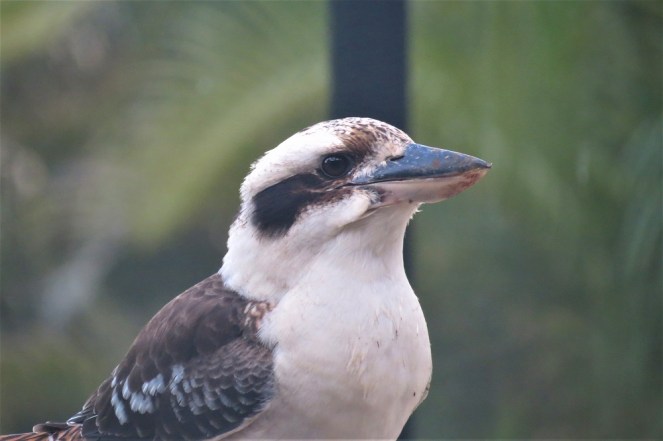
Another beautiful sight in the valley was a pair of kookaburras perched on a strong branch in a gum tree.
I completed a university assignment yesterday for the diploma course I started last year, the Diploma of Sustainable Living. I’ve been slotting a unit in here and there amid the Bachelor of Arts I started in second semester of 2017, and so far I’m coping okay. Units are often on offer during out-of-semester time slots, but this semester I’m studying one unit for the diploma and two for the BA, all at the same time.

The assignment I completed yesterday was for a unit I’m doing called Backyard Biodiversity. We were asked to choose one creature, be it birds, amphibian, mammal, or whatever else we may have seen in our yard, research the requirements for our chosen backyard buddy, then answer a series of questions for the assignment.

Any guesses on who I chose? 😉
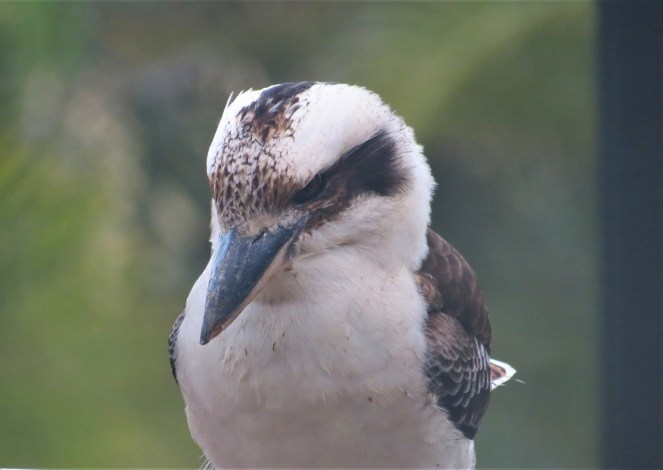
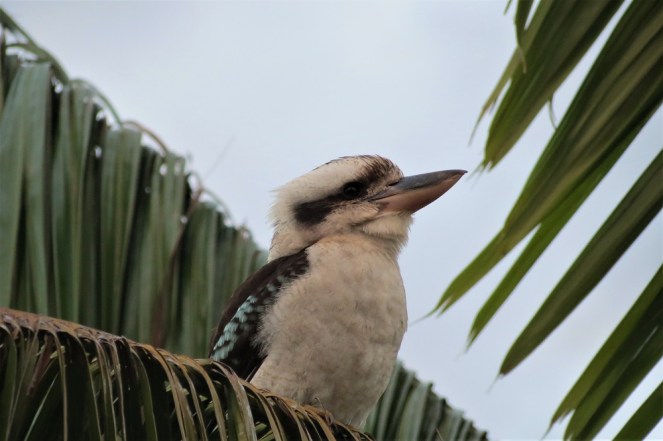
The Laughing Kookaburra, (Dacelo novaeguineae) is a most interesting little character, which I already knew of course. But even I had a lot to learn about the habits of these gorgeous guys who visit my garden daily. I’ll add the information here straight from my assignment –
“Discuss the biological needs of your selected species:

I’ve always suspected the twelve kookaburras who visit my garden were one family, and now I can relate that information to my lovely visitors – my original visitor, who I named Larry, always came into my garden alone. After a while he brought along a little lady friend who I named Shilo. Those two kookaburras have learned to trust me, and I can now hand-feed both of them. They still visit.
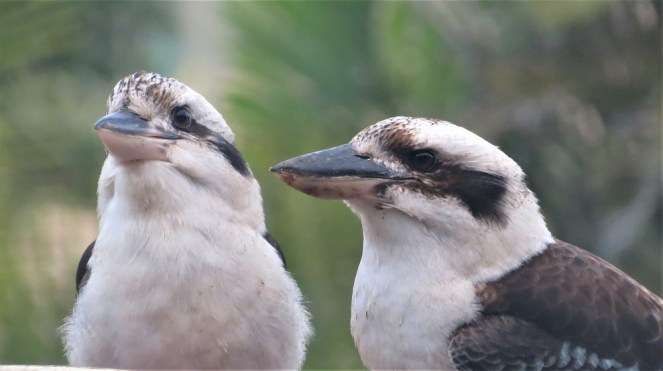
Meanwhile, the family has grown. I had always wondered if other kookaburras had joined my original family from elsewhere, but from what I have read, Larry and Shilo are the dominant breeding pair, making all the rest siblings who remain with their family.
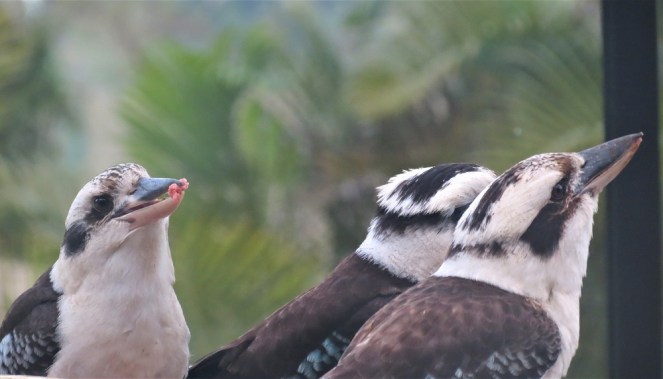
I also read that kookaburras are usually the first birds you’ll hear in the morning and the last you’ll hear at night. Just after finishing my assignment, I went out into my garden, and what did I hear? A collective chorus of kookaburras, laughing, right down the bottom of my garden! They may have a favorite tree just beyond my yard, but the were close. With my new-found understanding of their habits, hearing the kookaburras last night, right on nightfall when there were no other bird-sounds to be heard, I felt privileged to know they were so close, and that they had chosen a “favourite” tree to rest in so close to my home.
I have also learned this week that kookaburras were seen by the early settlers in Australia, and were noted as a species of bird they had never seen before. In 1788, the kookaburra was identified as a “Giant brown Kingfisher”. I found this information in a book I just bought called Journals of the First Fleet, which is the journal entries of Captain Arthur Phillip and Lieutenant General Watkin Tench, who both arrived in Australia with the first fleet of convicts, brought here to settle on our shores. Many of these convicts, mainly from England and Ireland, are the ancestors of Australia’s current inhabitants.

The drawing depicts details of the Great brown Kingfisher which we can easily identify as our Laughing Kookaburra. And here is the information accompanying the picture, and written in the 1788 journal …

Isn’t it strange to think we see the very same birds species today, even sounding the same, as they did back in 1788? Barbara spoke about this concept in her post The Continuation of Life. Since I read Barbara’s post, the thought has remained with me, and every now and then I try to drag past situations into the current age. I have also tried to “see” things from the point of view of people who lived 200 years ago. I don’t believe it is possible to understand what life was like for people living so many years ago, nor do I believe it is fair for us to place judgements on them based on the values we have today. Yet my contemplations have made people of the past seem more “real” somehow, although that’s another concept that is difficult to explain. Of course they are real! But it is difficult to imagine them as real because we didn’t know them.
I wonder if that is why lately people the world over are showing so little respect for people of the past? You know the people I mean, those who are trying to rewrite history books and smash statues that are there to honour the achievements and sacrifices people of the past made in an effort to forge a better world for future generations.
It is not for us to judge the decisions made by people who lived so long ago. No one can change the past, and as life continues, so different to the way it was 200 years ago, I find it comforting to realise that those early settlers heard and saw the same Laughing Kookaburras that I admire every day in my garden.

There was another beautiful sunrise this morning, complete with patches of cloud catching the early morning rays. Right across the southern skies, pale pink hues gradually changed to orange as I took several photos.
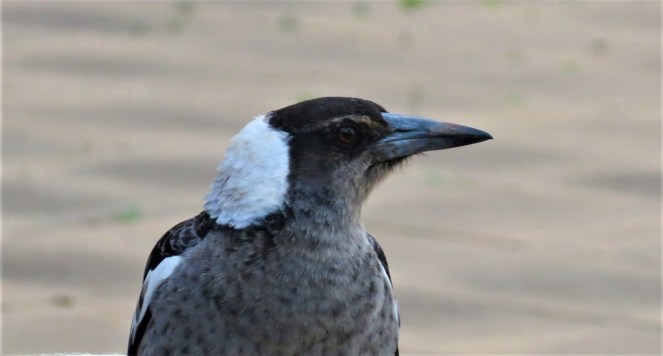
The birds were in fine form this morning too, I could hear them chirping all around me, while beside me baby Magpie yodeled his scratchy, youthful tones.

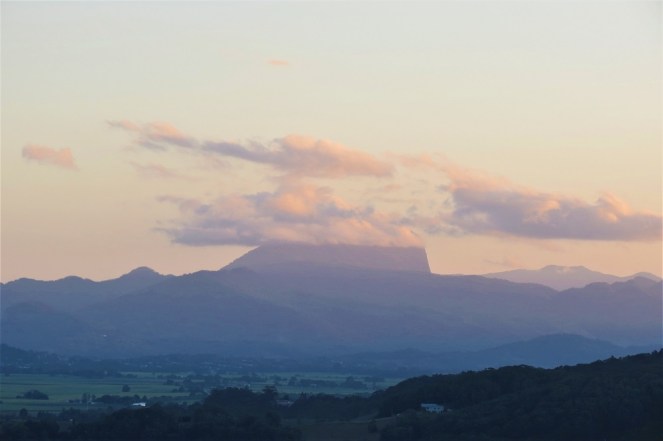
I spent the day indoors, working on a university assignment, so didn’t venture outside again until tonight. It was just past sunset but not quite nightfall. The sky was just a tad darker than I would have liked, but I decided to take a photo anyway, looking across the village of Tumbulgum and the town of Murwillumbah, with the black silhouette of Mount Warning and the ranges in the background.
That’s all for today. It’s getting late, but I already have an idea of what I will write about tomorrow when my eyes are not feeling so weary. I have been reading some very interesting facts about kookaburras, which I will share tomorrow. 🙂
 In My World