

Author: Joanne
Portrait of a Twenty-Year-Old
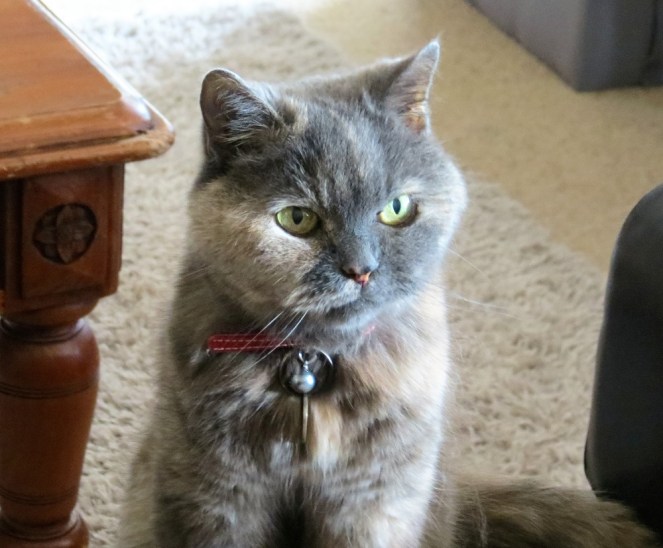
She made it! The Queen of my pets, beautiful Phoebe, celebrated her twentieth birthday on Sunday. Or should I say her people-family celebrated for her. I’m sure Phoebe thought it was just another day of sleeping, eating and having snuggles with her people.
Phoebe gave us quite a scare just over a week ago. We thought she wouldn’t see her twentieth – that’s ninety-six in human years – but after spending a night at the vets on an intravenous drip containing fluids and antibiotics, she came home again the next day. She amazed our wonderful vet by pulling through! He was convinced we’d all but lost her.
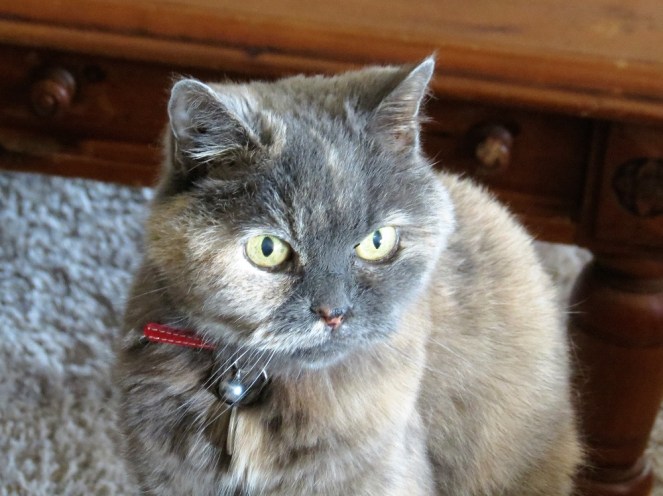
I wasn’t convinced. I needed to find out the problem before I could make that unmentionable decision. And I’m so glad I did.
She’s still on medication for a severe infection, but look at her now – bright-eyed, happy, and purring with contentment.
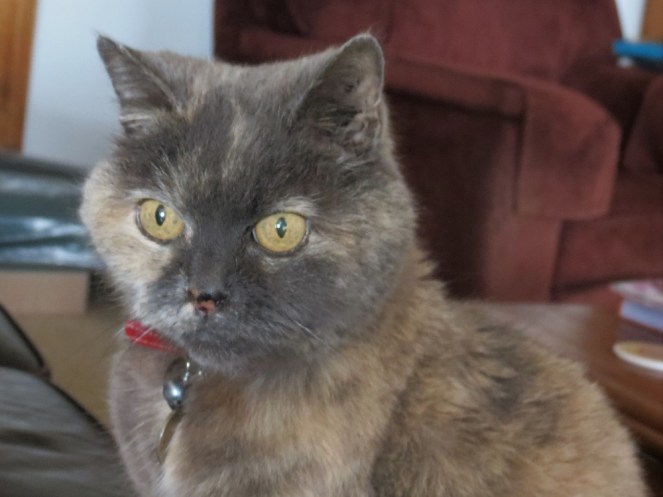
Phoebe was born on the 3rd February 1999. My kids – who were all still little ones at that time – found her in a pet shop. How could any of us resist her? We brought her home with us in April 1999, and she’s ‘grown up’ with my children, various dogs, birds, cats who have lived here temporarily when one of my children have moved back home, and she takes our busy household in her stride.

For the first ten years that we had Phoebe she was an outdoor cat, venturing out every morning, returning home either when it rained, or it was time for dinner. After she came indoors for her meal, that’s where she stayed for the night, usually curled up on the end of my bed. When we started to notice her panic when we let her outdoors, we decided to keep her inside. We’ve been told that she probably started to lose her eyesight around that time. And in the last couple of years we’ve noticed her hearing isn’t the best either. When the arthritis set in, she stopped jumping up onto my bed at night, but she still loves to curl up on a comfy chair.

It would be lovely if Phoebe made it to another birthday, and maybe she will. But for now, I’m just so thankful she’s well. And happy. ❤
Book Review – The Sewing Machine.

When my blog-buddy Nicki at the Secret Library Book Blog posted that she intended reading The Sewing Machine by Natalie Fergie, it reminded me that I wrote a review of the book last year for a university assignment. When reading through the review today I had to make a few changes to remove evidence of it once having been an assignment, but I’ve left the basics intact.
******
There’s a great deal to like about Natalie Fergie’s debut historical fiction novel The Sewing Machine. The inter-generational weaving of lives, and the social context of various time periods intertwining events spanning over one-hundred years form a complex narrative of intrigue.
In March 1911, Jean and her fiancé Donald, both workers at the Singer sewing machine factory in Clydebank Scotland, become embroiled in a strike at the factory. When Donald loses his job, the couple relocate to Edinburgh, where the story begins to weave its way through several fateful events in the lives of four generations of two families.
The catalyst, a message written by Jean and wrapped around a bobbin before she left the Singer factory is discovered by Kathleen after she purchases a new machine. This message, and the part the machine plays in the lives of each owner as it passes through the generations remains the focus of the story.
The last owner of the sewing machine, Fred, who we meet in 2016, is an unemployed blogger. He is the great-grandson of Kathleen, and inherits the sewing machine as part of his grandparent’s estate. After his fateful meeting with the great-granddaughter of Jean, the two descendants unravel the mystery of the message written in 1911.
I have just one criticism to make regarding the structure of The Sewing Machine. As captivating as the story is, I found the emotional connection between character and reader hindered by the introduction of three protagonists within the first nineteen pages, with each living in a different time period. In the beginning, the plot was difficult to follow. Further preventing intimacy with each protagonist, little is mentioned about their appearance. In an interview with Anne Bonny, Fergie claims she “painted each character’s appearance with a light brush” to enable the reader to form a picture of the person through their personality, avoiding any “long-winded physical descriptions”.
Unfortunately, descriptions of a nurse dressing for her shift on page 178 are long-winded. The paragraph begins with “she assembled the uniform in stages, fixing the collar on to the dress with three studs”. After a detailed fifteen-line commentary of a nurse dressing, complete with accessories, the nurse “gathered her red woolen cloak around her and set off, past the discreetly signed mortuary and up the steps to the long surgical corridor”. With similar detailed narrative of the characters lacking, I formed mental images of faceless people while reading.
At times, it is difficult to foresee how all elements of the story will come together. By the conclusion, however, the connection of every significant event occurring within the two families over one-hundred-and-five years is cleverly explained.
I read The Sewing Machine over four days during April 2018 and my rating for the book on Goodreads is four stars.
Silent Sunday

Silent Sunday


