Not a happy gardener, because it’s too wet for me to do any gardening today. My garden is extremely happy though, due to a good, solid soaking of rain that has hardly let up all day.
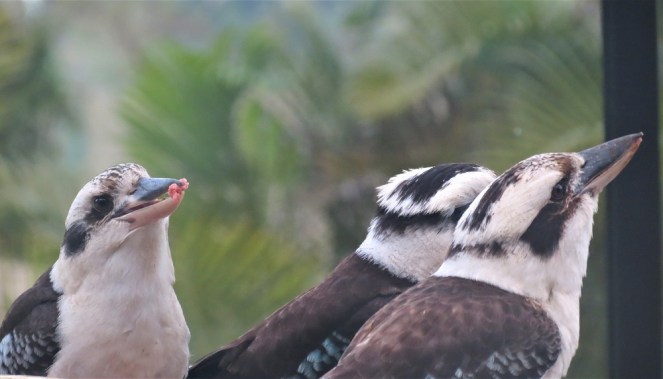
When I saw a magpie, a currawong, and two kookaburras outside my kitchen window this morning, my first thought was one of amusement – they are social distancing! Then I thought, but this is the way birds always act. They never get into each other’s space, they wait patiently, distanced from one another. No, not social distancing at all. I believe birds understand – they have always known – that they each need their own “personal space”.
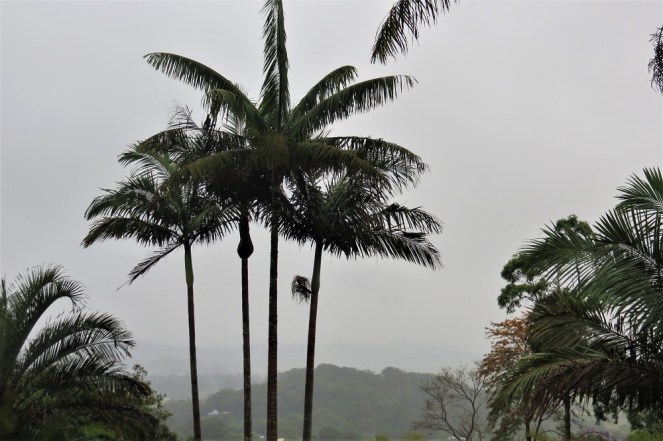
There’s nothing to see today where the mountain can usually be seen sitting in all her splendour. Nothing but mist and rain. I took all of my outdoors photos today from either inside, or standing on my back veranda. It’s too wet to venture any further.
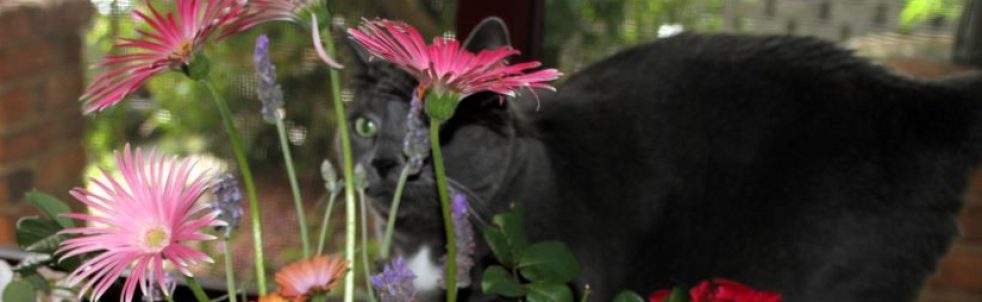
I have spent most of today indoors, sorting through masses of papers which have littered my desk for the past three months while I have been engrosed in uni study and assignments. I plonked a grey blanket on top of my sewing table a few weeks ago, and Miss Tibbs seems so happy with it being there that I haven’t had the heart to move it. Now, she sleeps on the blanket, and when she’s not sleeping she’s kneading the blanket! That’s why one of her paws is blurred in the photo – up and down her little paws went, kneading away as happy as could be.
I’m pretty happy too – just look at my desk-top! No really, look at it, because you can! And I can too! This is a rare event! I usually have so many piles of this, that and the other on my desk, but today they have either been thrown in the recycle bin, or put away where they belong. Bliss! ❤
I have another blissful sight to share too – a pile of books that I have been collecting over the past months of uni. I’m reading two book now, and will work my way through these, and others, during the next few months.
In another week’s time, I think I might have my life sorted and back in order. 🙂
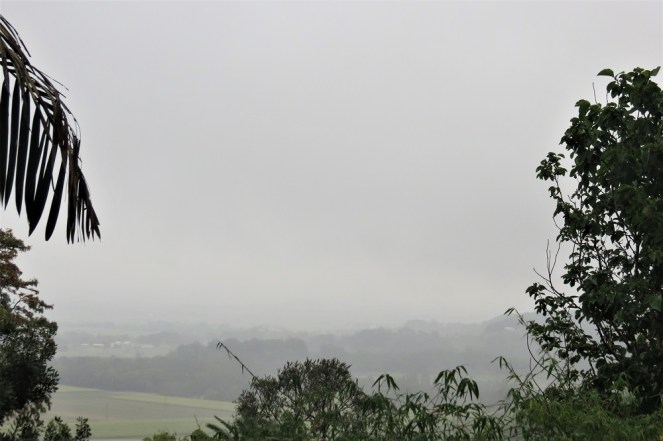
‘Twas another misty morning today. The mist wasn’t as thick as it has been recently, but it looked lovely all the same.
The mist sat in pretty pockets all through the valley, like a puffy layer of cotton wool blanketing the earth.
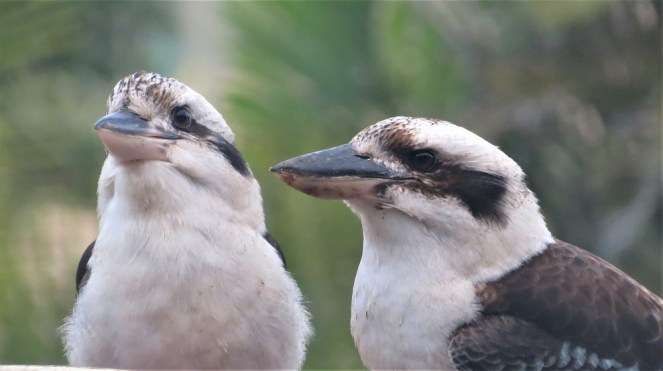
Another beautiful sight in the valley was a pair of kookaburras perched on a strong branch in a gum tree.
I completed a university assignment yesterday for the diploma course I started last year, the Diploma of Sustainable Living. I’ve been slotting a unit in here and there amid the Bachelor of Arts I started in second semester of 2017, and so far I’m coping okay. Units are often on offer during out-of-semester time slots, but this semester I’m studying one unit for the diploma and two for the BA, all at the same time.
The assignment I completed yesterday was for a unit I’m doing called Backyard Biodiversity. We were asked to choose one creature, be it birds, amphibian, mammal, or whatever else we may have seen in our yard, research the requirements for our chosen backyard buddy, then answer a series of questions for the assignment.
Any guesses on who I chose? 😉
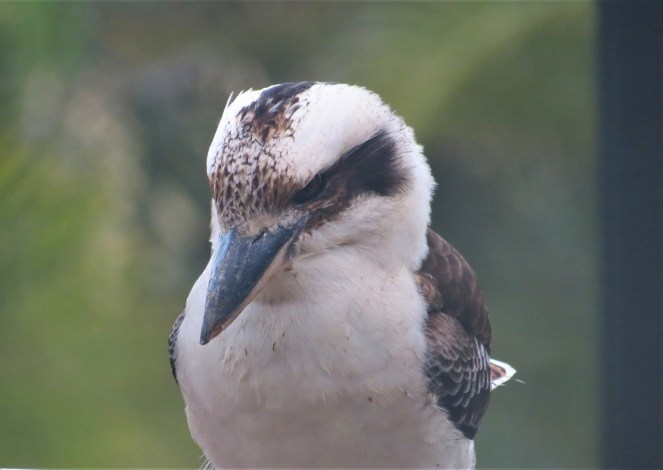
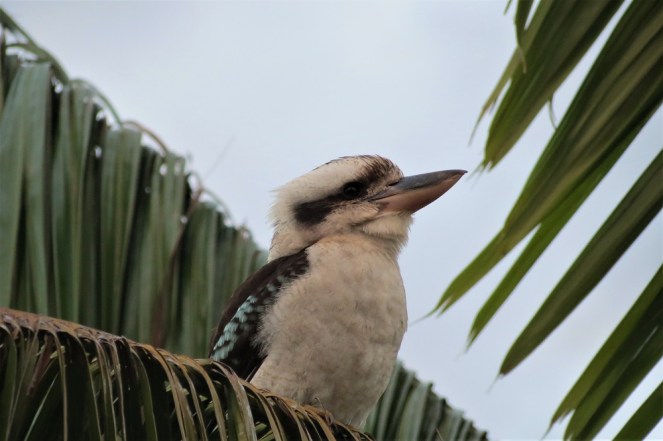
The Laughing Kookaburra, (Dacelo novaeguineae) is a most interesting little character, which I already knew of course. But even I had a lot to learn about the habits of these gorgeous guys who visit my garden daily. I’ll add the information here straight from my assignment –
“Discuss the biological needs of your selected species:
For food, this species requires: worms, insects, lizards, snails, grasshoppers, small snakes, and unfortunately, amphibians. Kookaburras are carnivores, and also eat small mammals, rats and mice. They occasionally eat crustaceans. When larger items of food are caught, a kookaburra will bash their meal against a tree branch or on the ground to kill, or “tenderise” the food before eating it.
For shelter, this species requires: large eucalyptus trees with strong branches and natural hollows to shelter in. Kookaburras are family orientated and choose favourite trees in which to sleep together for approximately twelve hours each night. They often begin and end the day with a collective raucous chorus of “laughter”. In cold or wet weather, kookaburras huddle together for warmth in their chosen tree for lengthy periods of time.
For water, this species requires: clean water for drinking, although similar to owls, most of a kookaburra’s water requirement is obtained through their food. Being the largest members of the Kingfisher family, however, they enjoy bathing in water, therefore need to have access to water for this purpose.
For space, this species requires: a large area with plenty of eucalyptus trees. Kookaburras live in large, sociable family groups, they mate for life, and the dominant breeding pair of the group keep their young with them after reaching maturity to help tend future clutches. Kookaburras also occupy forests and woodlands, ideally where open ground areas offer clear visibility for spotting food. Kookaburras are territorial and their territory can cover several hectares of space, but they are respectful of other kookaburra families and will not encroach on spaces already claimed.
Other things this species requires are: safe retreats from predators. A main enemy of the kookaburra is domestic animals. During September to January, which is their breeding season, kookaburras also require a safe hollow in a tree which is large enough for the mother to lay approximately one to four eggs. Elevated termite mounds can also be hollowed out to build their nests in.”
I’ve always suspected the twelve kookaburras who visit my garden were one family, and now I can relate that information to my lovely visitors – my original visitor, who I named Larry, always came into my garden alone. After a while he brought along a little lady friend who I named Shilo. Those two kookaburras have learned to trust me, and I can now hand-feed both of them. They still visit.
Meanwhile, the family has grown. I had always wondered if other kookaburras had joined my original family from elsewhere, but from what I have read, Larry and Shilo are the dominant breeding pair, making all the rest siblings who remain with their family.
I also read that kookaburras are usually the first birds you’ll hear in the morning and the last you’ll hear at night. Just after finishing my assignment, I went out into my garden, and what did I hear? A collective chorus of kookaburras, laughing, right down the bottom of my garden! They may have a favorite tree just beyond my yard, but the were close. With my new-found understanding of their habits, hearing the kookaburras last night, right on nightfall when there were no other bird-sounds to be heard, I felt privileged to know they were so close, and that they had chosen a “favourite” tree to rest in so close to my home.
I have also learned this week that kookaburras were seen by the early settlers in Australia, and were noted as a species of bird they had never seen before. In 1788, the kookaburra was identified as a “Giant brown Kingfisher”. I found this information in a book I just bought called Journals of the First Fleet, which is the journal entries of Captain Arthur Phillip and Lieutenant General Watkin Tench, who both arrived in Australia with the first fleet of convicts, brought here to settle on our shores. Many of these convicts, mainly from England and Ireland, are the ancestors of Australia’s current inhabitants.
1788 drawing of a kookaburra.
The drawing depicts details of the Great brown Kingfisher which we can easily identify as our Laughing Kookaburra. And here is the information accompanying the picture, and written in the 1788 journal …
Isn’t it strange to think we see the very same birds species today, even sounding the same, as they did back in 1788? Barbara spoke about this concept in her post The Continuation of Life. Since I read Barbara’s post, the thought has remained with me, and every now and then I try to drag past situations into the current age. I have also tried to “see” things from the point of view of people who lived 200 years ago. I don’t believe it is possible to understand what life was like for people living so many years ago, nor do I believe it is fair for us to place judgements on them based on the values we have today. Yet my contemplations have made people of the past seem more “real” somehow, although that’s another concept that is difficult to explain. Of course they are real! But it is difficult to imagine them as real because we didn’t know them.
I wonder if that is why lately people the world over are showing so little respect for people of the past? You know the people I mean, those who are trying to rewrite history books and smash statues that are there to honour the achievements and sacrifices people of the past made in an effort to forge a better world for future generations.
It is not for us to judge the decisions made by people who lived so long ago. No one can change the past, and as life continues, so different to the way it was 200 years ago, I find it comforting to realise that those early settlers heard and saw the same Laughing Kookaburras that I admire every day in my garden.
I’ve spent most of the day today at the computer, reading, and feel just a tad cross-eyed tonight. It’s been a long day with uni today, what with reading, an online quiz, and preparing for an assignment. At least the assignment is fairly small, but it’s due by Sunday night.
Around 2pm I took a break from my computer and went for a wander down the back garden. I thought it might be a nice change to take a photo of Mount Warning from further down my yard, where I can look up to the mountain towering above me and the cane fields are closer. It was a dull day again today, and I could see rain in the valley. It didn’t reach my house though.
On my way back to the house I took a detour into our pool area. We haven’t been spending much time in that area lately, but the hibiscus hedge that I pruned about a month ago has quite a lot of new growth on it already. We plan on making a few changes to the garden in the pool area before summer, so that will be a section of my garden that I’m sure I’ll be sharing photos of over the coming weeks. The only flowers near the pool just now are a few day-lilies, which I thought look quite pretty.
I’m heading off to bed now. I have a Mills and Boon romance novel to read for one of my units, Popular Genres. It’s not my usual choice of reading, in fact I don’t think I’ve ever read a Mills and Boon before now. There are only just over two-hundred pages, so hopefully it’s an easy read. I’m not expecting it to be a book I will highly recommend others read! I also have to read Dr No by Ian Fleming, which I’ve started reading and it seems like a pretty good read. After that, I’ll be reading Harry Potter and the Philosopher’s Stone – my first Harry Potter book, which I’ve borrowed from my daughter, who has read all the Harry Potter books three times! She’s very happy that I’m finally reading a H.P. book, even if it’s for uni. After that I’m reading Tolkien’s The Hobbit.
If everything goes to plan over the weekend, I’ll have time for some reading, gardening, and have my assignment finished in plenty of time before the deadline. 🙂
When my blog-buddy Nicki at the Secret Library Book Blog posted that she intended reading The Sewing Machine by Natalie Fergie, it reminded me that I wrote a review of the book last year for a university assignment. When reading through the review today I had to make a few changes to remove evidence of it once having been an assignment, but I’ve left the basics intact.
******
There’s a great deal to like about Natalie Fergie’s debut historical fiction novel The Sewing Machine. The inter-generational weaving of lives, and the social context of various time periods intertwining events spanning over one-hundred years form a complex narrative of intrigue.
In March 1911, Jean and her fiancé Donald, both workers at the Singer sewing machine factory in Clydebank Scotland, become embroiled in a strike at the factory. When Donald loses his job, the couple relocate to Edinburgh, where the story begins to weave its way through several fateful events in the lives of four generations of two families.
The catalyst, a message written by Jean and wrapped around a bobbin before she left the Singer factory is discovered by Kathleen after she purchases a new machine. This message, and the part the machine plays in the lives of each owner as it passes through the generations remains the focus of the story.
The last owner of the sewing machine, Fred, who we meet in 2016, is an unemployed blogger. He is the great-grandson of Kathleen, and inherits the sewing machine as part of his grandparent’s estate. After his fateful meeting with the great-granddaughter of Jean, the two descendants unravel the mystery of the message written in 1911.
I have just one criticism to make regarding the structure of The Sewing Machine. As captivating as the story is, I found the emotional connection between character and reader hindered by the introduction of three protagonists within the first nineteen pages, with each living in a different time period. In the beginning, the plot was difficult to follow. Further preventing intimacy with each protagonist, little is mentioned about their appearance. In an interview with Anne Bonny, Fergie claims she “painted each character’s appearance with a light brush” to enable the reader to form a picture of the person through their personality, avoiding any “long-winded physical descriptions”.
Unfortunately, descriptions of a nurse dressing for her shift on page 178 are long-winded. The paragraph begins with “she assembled the uniform in stages, fixing the collar on to the dress with three studs”. After a detailed fifteen-line commentary of a nurse dressing, complete with accessories, the nurse “gathered her red woolen cloak around her and set off, past the discreetly signed mortuary and up the steps to the long surgical corridor”. With similar detailed narrative of the characters lacking, I formed mental images of faceless people while reading.
At times, it is difficult to foresee how all elements of the story will come together. By the conclusion, however, the connection of every significant event occurring within the two families over one-hundred-and-five years is cleverly explained.
I read The Sewing Machine over four days during April 2018 and my rating for the book on Goodreads is four stars.
This morning, the university study schedule and information has been released for the two units I am enrolled in for session one, which begins next week, and as I printed out Study Guides and Unit Information Guides this morning I felt the familiar bubble of excited anticipation I usually feel at the beginning of a new learning journey.
Mingled with the excitement, however, I also experienced a fairly large chunk of trepidation.
I’m enrolled in the Associate Degree in Creative Writing and have so far completed three of the sixteen units. The first two units, which I completed well before the end of last year in session two of the study year, progressed wonderfully. Nothing untoward happened, I learned lessons which I will continue to carry with me throughout the associate degree and beyond, and I became friendly with some like-minded, ‘mature aged’ students who are experiencing a similar learning process to my own. I took the opportunity to complete my third unit over the Christmas/New Year period, during session three, again feeling eagerness and anticipation over the content of the coming twelve weeks study and assignment tasks.
It was during the latter weeks of this third unit that I began to feel the effects of information overload, brought about by political leanings, opinionated unit content and the evident desire of the authors of the learning materials to neatly package groups of people together in what they described as minority group and label each group with its (apparent) appropriate sticker.
At the point in the unit that I began questioning the learning process, we were discussing the book Jane Eyre by Charlotte Brontë.
An academic may, upon the mention of Jane Eyre, nod knowingly and mutter ‘ah yes, Jane Eyre‘, whilst realising the popular train of thought offered by university lecturers and those people who possess a biting, critical and analytical mind for all texts written since the beginning of time. For the uninitiated student such as myself, however, the Study Guide materials and ensuing discussions came as something of a shock.
What did I expect when I enrolled in this unit? Jane Eyre was listed as one of the Written Texts students would study during this unit, along with several other books. I’ve read Jane Eyre and although I found Brontë’s 19th-century style of speech difficult to read in the beginning, after the first few pages I began to enjoy the experience of reading a book written authentically in the time frame. Historical writing, such as Diana Gabaldon’s Outlander series, whilst written historically, were not written in 1743, the year in which the female protagonist, Clare Randall, found herself after falling through a time-warp amid the stones at Craigh na Dun during a visit to Scotland in 1946. Jane Eyre, on the other hand, was published in 1847 and written during a time when females were not regarded as having anything worthwhile to say and not accepted as authors worthy of publication. Charlotte Brontë, like other female authors of her time, stepped around this technicality by releasing her early writing under the nom de plume of Currer Bell, a fact which I found fascinating and a sign of those times. During reading Jane Eyre I marvelled at the changes in society during the past one-hundred-and-seventy years and silently thanked the suffragettes, and various other the women throughout time who have fought the battle, and won, for equal right for women. I had expected discussions throughout this unit to be comparisons of writing styles during various time frames; I expected admiration for female authors, such as Charlotte Brontë who led the way in fighting a male dominated society, hence breaking down the barriers, enabling the opportunity for me to write today.
I was wrong. We were expected to read the assigned texts from the only point of view we have available to us, which is now, placing all of the judgements we know to be ‘correct’ today, on a text which was written one-hundred-and-seventy years ago. Apparently, Charlotte Brontë wrote from a narrow and limited point of view and should have known better than to portray Rochester’s first wife as a Creole, which (apparently) emphasised the bigoted outlook of the English.
This line of discussion, (especially relating to the apparent prejudice of English folk whose soul purpose was to colonise and the entire world) was held right at the time when heated debate was rife over Donald Trump’s controversial election as the American President. And perhaps this unit’s discussion board conversations fell victim of the overflow of anguish spilling across from the other side of the world. It didn’t help the situation any when these events coincided with Australia celebrating yet another ‘Australia Day’, meant to bring the citizens of this country together as we sing the praises of the country we love, yet in recent years has been described as ‘invasion day’ by some people who are indigenous, part indigenous or indigenous sympathisers in this country. Before I realised what was happening, the discussion board debate turned political. In the university environment, where the study guides describe our once heralded ‘Australia Day’ as invasion day (a point which I usually overlook, and read on) my once-expected-to-be pleasurable debate and learning experience turned into an emotionally draining nightmare.
If you have read this far, and are a regular reader of my blog posts, no doubt you are asking why I chose to participate in the discussion board debacle, when it obviously upset my equilibrium. Ten percent of the grade awarded at the end of the unit is assessed on personal participation to the discussion board. I seriously considered whether it was worth the ten percent, but as the unit was nearing the end when I became positively rattled, I chose to stick it out.
As I begin to study two new units, again verging into the unknown, I have not developed any expectations of the unit content. I now know to expect the unexpected, however, the trepidation is there. I do not wish to feel like an emotionally drained, rung-out old dish cloth at the end of what should be a pleasant learning journey. I hope that this most recent experience is a one-time event. I question how the topic of discussion I endured will help me to become a better writer, (which is why I signed up for the Associate Degree in Creative Writing) and will remain open to a proverbial penny dropping moment in the future.
For assignment 4, discussion board participation, my grade was a high distinction, yet in hindsight, I feel I paid too a high a price for the ultimate accolade, which was such a small aspect of the unit.
And please, anyone who feels inclined to comment regarding anything political or controversial, I respectfully ask you to please refrain from any such observations. These mentions were only made to describe a situation, not to open further debate.
Thank you, dear reader, for lending your ear (eye?) as I again venture into the unknown, this time literally prepared – in a suit of armour.







 In My World