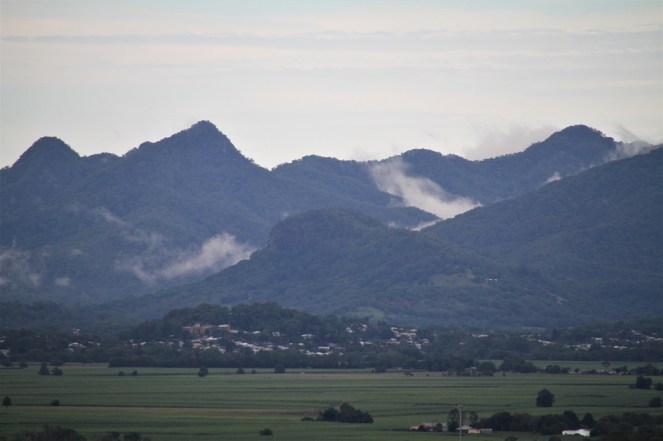
After heavy overnight rain, I hadn’t expected Mount Warning to look so clear this morning. When the view is as crystal-clear as it was today, it seems to have been washed clean by the rain.
Misty swirls lingered throughout the morning, very noticeable against the rich blue/grey/green colour of the ranges.
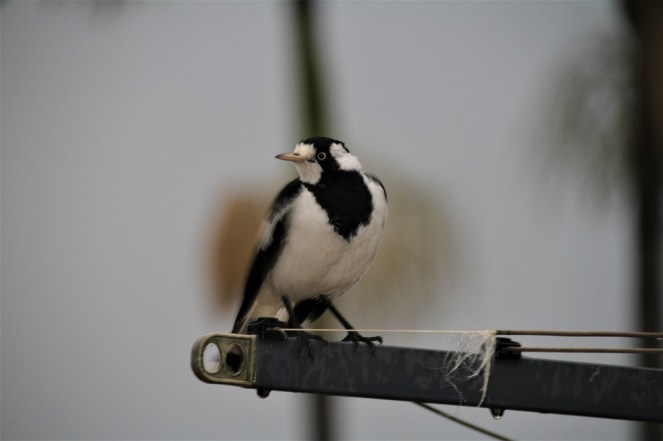
Also washed clean were the birds! This is a female magpie lark, or pee wee.
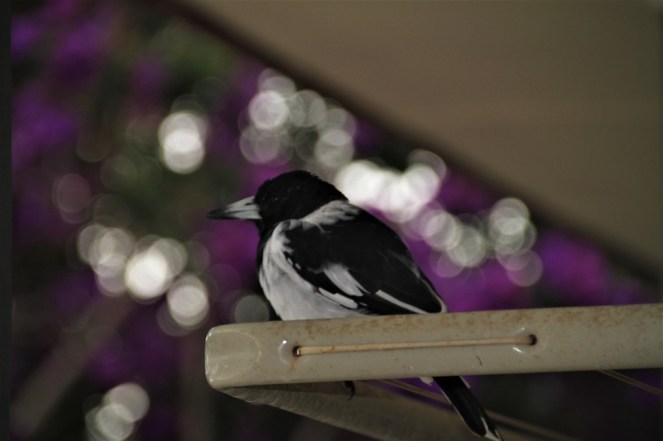
And this is one of two baby butcher birds I have visiting this year.
I particularly like this photo of Hoppy, sitting on my undercover clothes line – his preferred perch when he visits – with the morning sun glistening on raindrops caught in the purple tibouchina tree in the background. ❤
Hattons Bluff and the Hatton homestead. Photo taken c1869
On Australia Day this year – 26th January – the usual debate of who “owns” Australia broke out yet again. During one news channel interview, the interviewer ask the interviewee a very thought-provoking question. Without going into too much background as it is not a topic I wish to debate, although it adds context to my story, was this – If indigenous Australians were declared the “owners” of Australia, and all other nationalities of people were required to leave the country and go “home”, where in the world would the descendents of the early settlers, for example, move to, when Australia is the only home they have known for several generations?
This question opened up an interesting conversation between husband and myself. While I am a first generation Australian, my husband’s family, on all sides of his family tree, have lived in Australia for well over 100 years. The first of his ancestors arrived in 1833, while another early arrival was in 1853, that of Richard Hatton and his son, William. In every line of husband’s family tree, he is at least a fourth-generation Australian. After so many generations, the roots of his family tree are well anchored in this land.
William Hatton, husband’s two-times great-grandfather, was an early settler in the Tweed Valley region. William arrived in Australia in 1857 with his father, Richard. With Hattons Bluff being a well known landmark in the area, I have often asked husband in more recent years if his family might have a connection to Hattons Bluff. Husband didn’t know, and not being overly fond of family history, seemed disinclined to find out.
After the Australia Day debate, I became super-curious. Who was Hattons Bluff named after? Even if husband isn’t overly interested, I am the mother of four people who can confidentally claim to have roots in Australia which can be traced back seven generations. Besides, if there’s a story to be found, I want to know about it. 😉
Hattons Bluff c1930
As I searched for information about Hattons Bluff which could potentially tie into my husband’s Hatton family, I found several old photos of the area. I am sharing three of these photos today, however, I cannot add a credit for any photographers as no names were listed. Undoubtedly, these photos have been passed along through the generation and the owner, or owners, have kindly shared the images online. For this, I thank them.
These photos, and the information I discovered online have confirmed that Hattons Bluff was named after my husband’s two-times great-grandfather, William Hatton. Husband’s grandmother shared many memories about her mother, a daughter of William named Emma Hatton, in the early years of our relationship, and I have racked my brain to try and recall if she ever told us about her family’s connection to this local landmark. I don’t think she did, but perhaps she did tell us and we were too young to appreciate the magnitude of the knowledge. Or perhaps it wasn’t an important enough story to share. Perhaps she took for granted her place in this country, in this state, in the Tweed Valley region, just as my husband does.
For me, it is a surreal concept to imagine, knowing that you are walking in the footsteps of a previous generation – indeed several generations – of people who if it were not for them, you wouldn’t exist. My husband really doesn’t know how lucky he is to have that immensely strong connection to the land on which he lives today.
Or does he?
This morning, as the rising sun battled with clouds to find a place to shine upon earth, husband noted the mist, swirling around the south and western base of Hattons Bluff. It’s well defined this morning, he announced.
Do I detect just the teenist note of familial pride creeping in? 😉
There were a couple of showers of rain early this morning, so when I awoke at around 6:30 am, a few flimsy pockets of mist had formed in the valley.
My husband noticed mist surrounding Hattons Bluff, and suggested I take a photo. I had been complaining to husband that with all the rain we’ve had lately, I haven’t had a clear view of Huttons Bluff in ages. This morning, however, the mist circling the landmark accentuated its position next to Mount Warning.
Being interested in local history and family history, I had hoped that my husband would know something of the history of Hattons Bluff. Some time ago, I asked him what he knew about the area … “it’s next to Mount Warning” he told me. That was the extent of his knowledge! Being born and raised in this area, I had hoped he would know more, such as who the bluff was named after. Apparently not.
Now I have raised his curiosity, husband is curious about Hattons Bluff’s geographical position, so today, when business took him to the small town of Bray Park just outside of Murwillumbah, he took a closer photo of Hattons Bluff on his phone and sent it to me.
To the right of Hattons Bluff, Mount Warning can be seen peeking over the tops of the trees.
As for the history of Hattons Bluff, I have been doing some investigating, and have learned some information which I find intriguing! I will share my findings tomorrow. 🙂




 In My World