Usually I have a few kookaburras visiting the garden first thing in the morning. After I give them a little bit of mincemeat, off they go, and although I see them around the yard they don’t usually return until the next day looking for food. Around lunchtime today though, when I walked into the kitchen, there was a lone kookaburra, clearly waiting for a morsel. Of course I obliged, he probably missed out this morning – right?
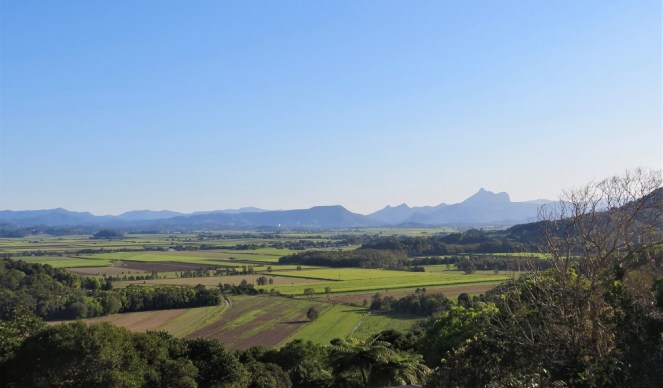
After lunch I decided to bake a batch of muffins – pumpkin and blueberry – which sounds like a strange combination but they are very tasty. I don’t have a sweet-tooth, so they suit me perfectly. Husband wasn’t so keen. I had suspected he might not be fussed, so I also made his favourite lemon loaf, which I’ve probably made a hundred times over the years. I needed a fresh lemon, so while the muffins were baking, the dogs and I went for a walk down the back to the orchard. And this is how the valley looked during the afternoon, beautiful, clear and sunny. It was a very fine day today.
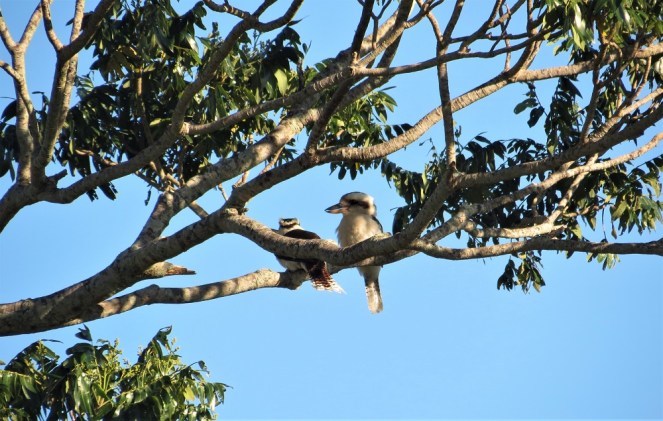
I heard kookaburras laughing nearby, so looked around and found two sitting together in one of the tall gum trees. I often hear them down there during the day, and also around sunset when they always have a good ole laugh!
This last photo might be a bit unexpected – it’s a blue-tongue lizard. They are completely harmless – unless they feel threatened, of course – so he or she is very welcome in my garden. They eat snails and other insects, and so long as it gets on well with my family of green tree frogs who live in the front garden, it can stay as long as it likes. I’m not sure why it decided to visit my front veranda, but it was an opportunity to get a good photo. I knew something was in my garden near the door because I often heard it rustling about. At least now I know it’s not a snake! 🙂
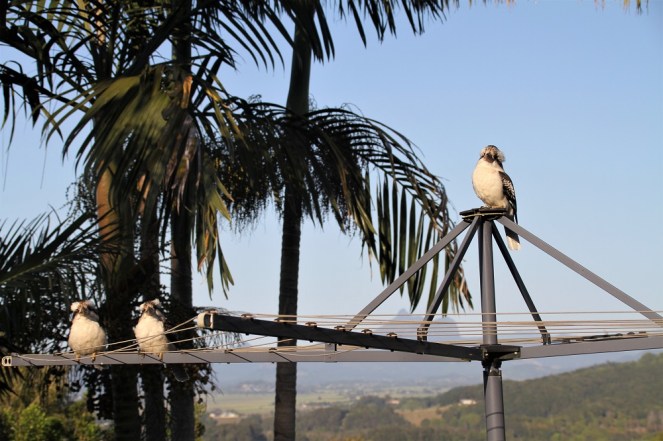
During the past week I’ve heard a few squabbles among the kookaburras and this morning they were fighting for top position on the clothesline! They are such funny characters and as you can see, this kookie is acting quite indignant over being challenged to his top spot!
The rain we have had during the last week has brought the brilliant greens out in the cane fields, so I just had to show you all how luscious the sugar cane is looking just now.
I have been working on a uni assignment today again, but during the afternoon husband asked if I could give him a hand with a few things in the back garden. He didn’t need to twist my arm! So after I had finished writing I grabbed my camera and joined him. He was pruning the tropical pear tree in the orchard, which is right down the bottom of the garden near the rear boundary, so I took a photo of the uninterrupted view of the valley from there.
While I helped with the pruning, I left my camera in the fork of the mango tree, wrapped in a flannelette shirt as there were a few spots of rain about. I had to grab my camera again though to take a photo of this little cutie, perched on the corner fence post, eyeing off the ground for sight of his dinner. (The fence is due to be replaced soon!)
The rain became a tad heavier just as the battery in the chainsaw died, so I headed to the shelter of the bar-be-que area to wait for the shower to pass. It was quite late in the day by that time, but I still managed to catch a photo of the raindrops hitting the pool water in the dimming light.
Over the past few days, my blogging friend, Carol, has been on my mind a lot. She lives in Oregon, near where the horrendous fires in the USA are, and she has been on constant evacuation alert. Carol spoke of the red orb of sun, and I knew what she meant as the sun took on that almost glowing, eerily red appearance during the latter months of last year and early this year in New South Wales, where I live. At that time I wasn’t blogging regularly, so I thought I’d post some photos that I took around that time today.
We lived with this strange yellow sky for about two months during November and December last year. The fires blazed across all of eastern Australia, but by some strange stroke of luck, our area remained safe, even though fires surrounded us for weeks.
This is the sun, taken on the 10th November, 2019. I remember the first day I noticed the change in the appearance of the sun. I was driving home, and I wondered why the moon was so bright, and so big, and in the western sky during the afternoon. It took me a few minutes to realise that it was actually the sun. It sure didn’t look like the sun!
Mount Warning looked hazy, and the sky yellow for weeks. Weeks went by without seeing any blue sky and the sun eventually turned into a glowing red orb. Everything looked so scarily unnatural and surreal.
Looking back on these photos now, they are so unreal that they seem as if they were Photo-shopped! Unfortunately, they are genuine. This is just how the sun looked in December last year.
I am posting these photos today as I don’t image – well, I hope and pray – that we will not have another summer the same as last summer. It was unsettling, to say the least. Complete towns were burned to the ground. During the year though, we have heard that fire trails have been cleared. We have also heard that many Aboriginal people, who understand the benefits of controlled burning to rejuvenate the bush and to prevent bush fires from burning out of control are now being listened to. I don’t know why it took a catastrophic event for the authorities to listen, but at least they are listening now. Also in our favor, we have had rain, after living through drought for most of last year. Also, more rain is predicted.
As for Carol in Oregon, I wish her well, and hope the fires surrounding her are soon under control. Carol can be found at Wanderings of an Elusive Mind. ❤
Being Saturday, I was able to have a bit of a sleep-in this morning. Not for long though. An hour after the usual time I get up, I heard kookaburras cackling outside my bedroom.
It was a beautiful sound to wake up to. And when I looked outside I saw two kookaburras looking at me expectantly. I wasn’t thinking about feeding them though, I made a bee-line for my camera!
The light of the morning was perfect for a photo session. The sky was blue, and the morning light crystal clear.
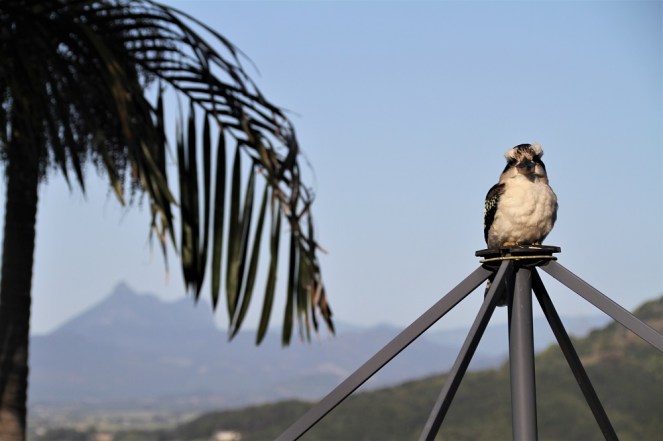
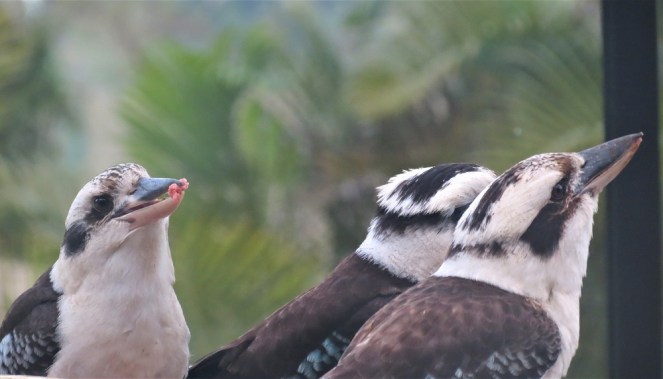
And I had not two, but three supermodels, posing, ready to begin their photo-shoot. Will you look at those synchronized poses!
As I clicked away, I noticed the view behind my clothesline. Okay, so the clothesline is arguably not the most glamorous prop for three such stunning models, but look at the view behind them! Unfortunately, I am just a tad short to get a decent shot of the mountain without the lines across it, but that was easily fixed.
I dragged an outdoor chair across to the right position, climbed up, and there you have it – supermodel kookaburra in front of an amazing backdrop! Mount Warning, palm trees, clear blue sky, who could ask for more?
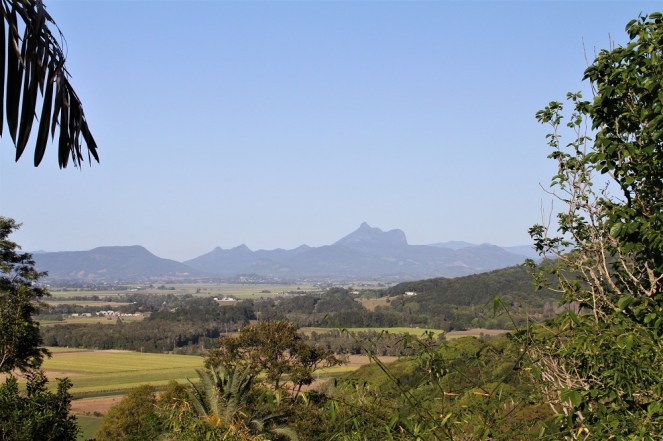
After waiting so long for the photographer to finish getting just the right shots, the supermodels were all famished! Some of their friends had arrived by that time too, so they all went off to the feeding table for breakfast. Oh, and I almost forgot! Here’s the mountain, looking gloriously spring-like, early on a fine Saturday morning. 🙂
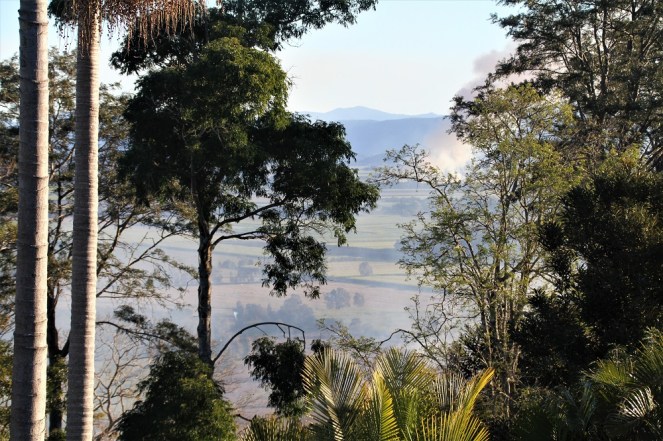
The hazy valley today, rather than being caused by nearby bush fires or dust-storms, was the result of a few good ole sugar cane fires. They seemed to be burning in all directions and filled the valley with smoke.
The thick tuft of smoke toward the top-right in the photo above is near the sugar mill. Which reminds me, I must take a drive down there and take a few close-ups one day.
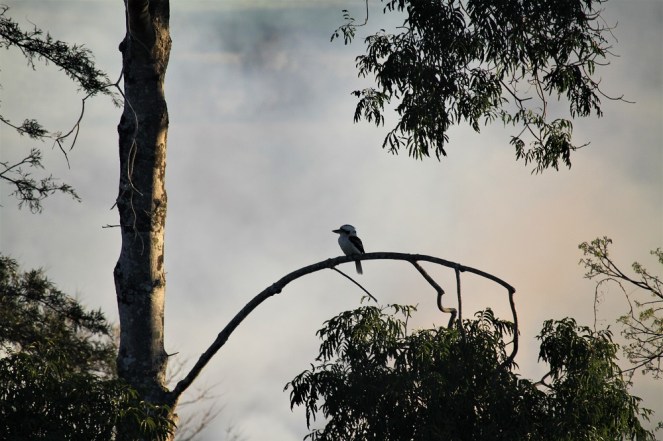
Usually when I take photos of kookaburras sitting on this branch, the green cane fields form a backdrop for the photo. Today, it was just smoke. The kookaburra didn’t seem to mind though.
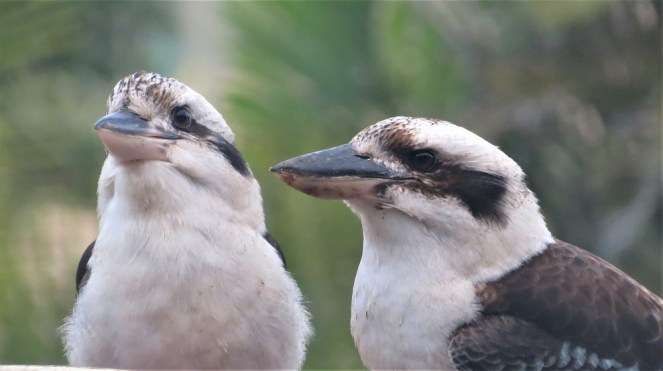
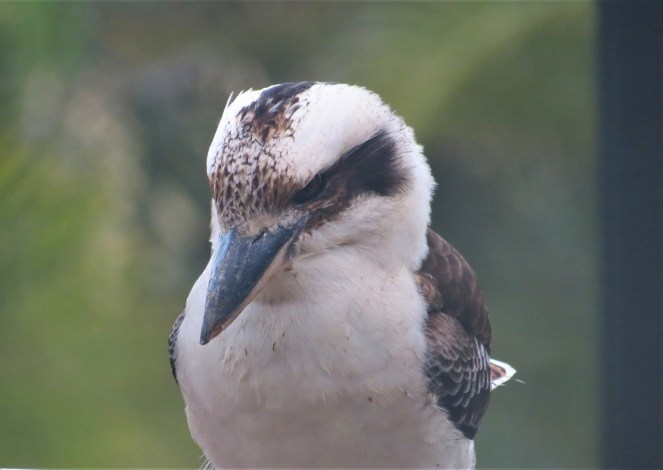
Earlier today I had a visit from Larry and Shilo, my two regular kookaburras who have been visiting for years. This is Shilo, hinting that it’s time for breakfast, I imagine, because she didn’t leave until after I had fed her and Larry.
We had other visitors for breakfast this morning too. Six sulphur-crested cockatoos landed in the palm trees near to the house and watched as I fed Larry and Shilo. They must have decided that minced meat wasn’t to their liking though, and soon flew down to the pecan tree. I didn’t realise there were any nuts left on the branches, but those observant cockatoos knew they were there.
I’m pretty excited about this rose bush. I transplanted it during the colder part of winter – although it is still pretty cool even now – and it has several buds on the bush. This is the second bud to open and I love the velvet texture of the petals. I felt I could be taking a chance transplanting three rose bushes that had lived in the same position for about ten years, but now I’m so glad I did. All three look much healthier than they ever have before, and being closer to the house now I can admire them more often.
One of the most photogenic flowers in my garden each year is the grevillea. The whole tree is covered in buds and blooms, and the native honey eating birds are loving it!
I’m working on a uni assignment again, so I don’t know how much time I’ll have for blogging and taking photos this week. At the very least, I’ll take one each day of Mount Warning. 🙂
‘Twas another misty morning today. The mist wasn’t as thick as it has been recently, but it looked lovely all the same.
The mist sat in pretty pockets all through the valley, like a puffy layer of cotton wool blanketing the earth.
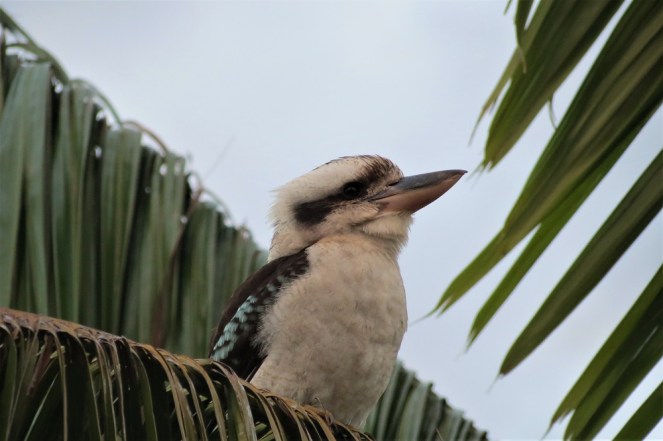
Another beautiful sight in the valley was a pair of kookaburras perched on a strong branch in a gum tree.
I completed a university assignment yesterday for the diploma course I started last year, the Diploma of Sustainable Living. I’ve been slotting a unit in here and there amid the Bachelor of Arts I started in second semester of 2017, and so far I’m coping okay. Units are often on offer during out-of-semester time slots, but this semester I’m studying one unit for the diploma and two for the BA, all at the same time.
The assignment I completed yesterday was for a unit I’m doing called Backyard Biodiversity. We were asked to choose one creature, be it birds, amphibian, mammal, or whatever else we may have seen in our yard, research the requirements for our chosen backyard buddy, then answer a series of questions for the assignment.
Any guesses on who I chose? 😉
The Laughing Kookaburra, (Dacelo novaeguineae) is a most interesting little character, which I already knew of course. But even I had a lot to learn about the habits of these gorgeous guys who visit my garden daily. I’ll add the information here straight from my assignment –
“Discuss the biological needs of your selected species:
For food, this species requires: worms, insects, lizards, snails, grasshoppers, small snakes, and unfortunately, amphibians. Kookaburras are carnivores, and also eat small mammals, rats and mice. They occasionally eat crustaceans. When larger items of food are caught, a kookaburra will bash their meal against a tree branch or on the ground to kill, or “tenderise” the food before eating it.
For shelter, this species requires: large eucalyptus trees with strong branches and natural hollows to shelter in. Kookaburras are family orientated and choose favourite trees in which to sleep together for approximately twelve hours each night. They often begin and end the day with a collective raucous chorus of “laughter”. In cold or wet weather, kookaburras huddle together for warmth in their chosen tree for lengthy periods of time.
For water, this species requires: clean water for drinking, although similar to owls, most of a kookaburra’s water requirement is obtained through their food. Being the largest members of the Kingfisher family, however, they enjoy bathing in water, therefore need to have access to water for this purpose.
For space, this species requires: a large area with plenty of eucalyptus trees. Kookaburras live in large, sociable family groups, they mate for life, and the dominant breeding pair of the group keep their young with them after reaching maturity to help tend future clutches. Kookaburras also occupy forests and woodlands, ideally where open ground areas offer clear visibility for spotting food. Kookaburras are territorial and their territory can cover several hectares of space, but they are respectful of other kookaburra families and will not encroach on spaces already claimed.
Other things this species requires are: safe retreats from predators. A main enemy of the kookaburra is domestic animals. During September to January, which is their breeding season, kookaburras also require a safe hollow in a tree which is large enough for the mother to lay approximately one to four eggs. Elevated termite mounds can also be hollowed out to build their nests in.”
I’ve always suspected the twelve kookaburras who visit my garden were one family, and now I can relate that information to my lovely visitors – my original visitor, who I named Larry, always came into my garden alone. After a while he brought along a little lady friend who I named Shilo. Those two kookaburras have learned to trust me, and I can now hand-feed both of them. They still visit.
Meanwhile, the family has grown. I had always wondered if other kookaburras had joined my original family from elsewhere, but from what I have read, Larry and Shilo are the dominant breeding pair, making all the rest siblings who remain with their family.
I also read that kookaburras are usually the first birds you’ll hear in the morning and the last you’ll hear at night. Just after finishing my assignment, I went out into my garden, and what did I hear? A collective chorus of kookaburras, laughing, right down the bottom of my garden! They may have a favorite tree just beyond my yard, but the were close. With my new-found understanding of their habits, hearing the kookaburras last night, right on nightfall when there were no other bird-sounds to be heard, I felt privileged to know they were so close, and that they had chosen a “favourite” tree to rest in so close to my home.
I have also learned this week that kookaburras were seen by the early settlers in Australia, and were noted as a species of bird they had never seen before. In 1788, the kookaburra was identified as a “Giant brown Kingfisher”. I found this information in a book I just bought called Journals of the First Fleet, which is the journal entries of Captain Arthur Phillip and Lieutenant General Watkin Tench, who both arrived in Australia with the first fleet of convicts, brought here to settle on our shores. Many of these convicts, mainly from England and Ireland, are the ancestors of Australia’s current inhabitants.
1788 drawing of a kookaburra.
The drawing depicts details of the Great brown Kingfisher which we can easily identify as our Laughing Kookaburra. And here is the information accompanying the picture, and written in the 1788 journal …
Isn’t it strange to think we see the very same birds species today, even sounding the same, as they did back in 1788? Barbara spoke about this concept in her post The Continuation of Life. Since I read Barbara’s post, the thought has remained with me, and every now and then I try to drag past situations into the current age. I have also tried to “see” things from the point of view of people who lived 200 years ago. I don’t believe it is possible to understand what life was like for people living so many years ago, nor do I believe it is fair for us to place judgements on them based on the values we have today. Yet my contemplations have made people of the past seem more “real” somehow, although that’s another concept that is difficult to explain. Of course they are real! But it is difficult to imagine them as real because we didn’t know them.
I wonder if that is why lately people the world over are showing so little respect for people of the past? You know the people I mean, those who are trying to rewrite history books and smash statues that are there to honour the achievements and sacrifices people of the past made in an effort to forge a better world for future generations.
It is not for us to judge the decisions made by people who lived so long ago. No one can change the past, and as life continues, so different to the way it was 200 years ago, I find it comforting to realise that those early settlers heard and saw the same Laughing Kookaburras that I admire every day in my garden.









 In My World