
Wordless Wednesday
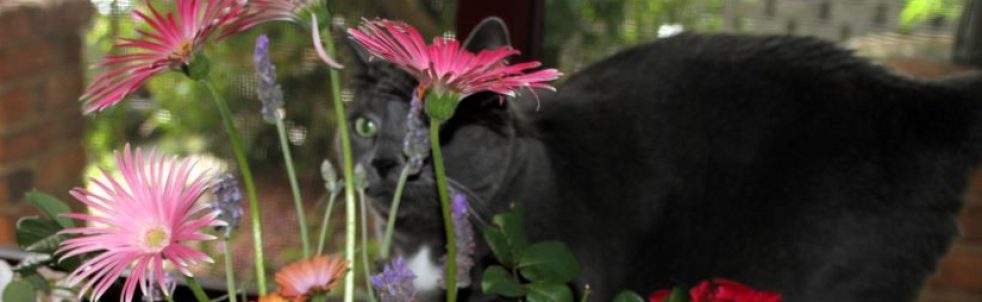
Hands-on experience at the critical time, not systematic knowledge, is what counts in the making of a naturalist. Better to be an untutored savage for a while, not to know the names or anatomical detail. Better to spend stretches of time just searching and dreaming. ~~ Edward O. Wilson.
My mind is not wired for science, and consequently the anotomical detail of plants has me bewildered. I’m more of a searcher and dreamer as I wander around my garden, taking photos, and I even feel completely comfortable if anyone wishes to regard me as an untutored savage. My garden brings me so much joy, and I love experimenting, wondering if plants will grow, and how they will grow if they survive my sometimes erratic subtropical climate. Will the new plant reach or exceed the suggested height on the label? Will they survive our dry, mild winters, or get ‘wet feet’ during our rainy season, summer?

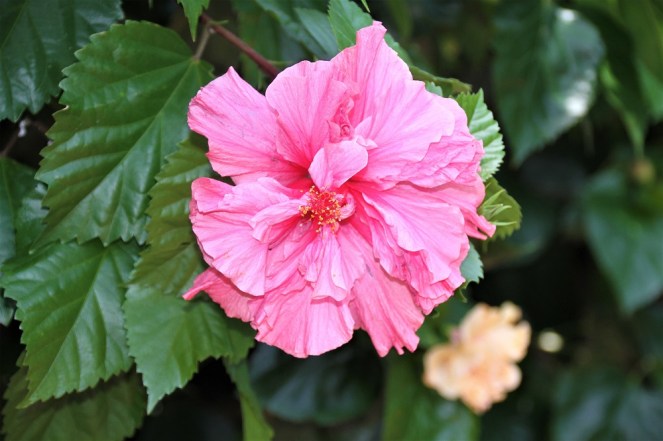
Today when I walked around one of the first areas we established in the garden twenty-six years ago, admiring the plants we planted back then that have survived – and flourished – throughout the test of time and seasons, I realised just how little I know about these plants. The pink flower is a hibiscus, but what variety of hibiscus? I found plenty of weathered hibiscus flowers on the hedge, but do they always develop new buds in January? Perhaps the wind and rain, which has many of the flowers looking battle-weary, has encouraged the plants to bloom again. I’m not sure.
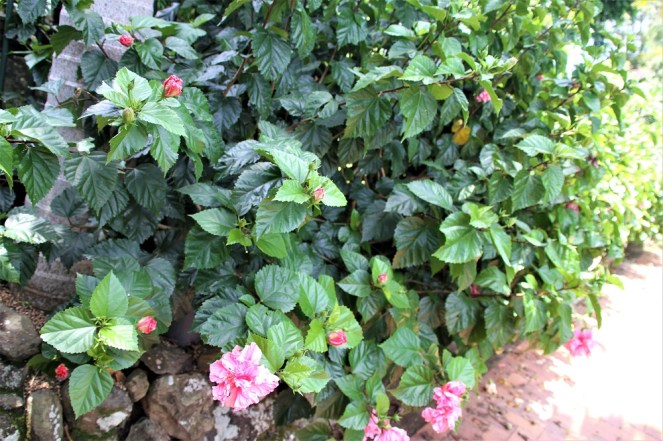
I must document these changes I see in my garden, for future reference. I noticed today that the western end of the hibiscus hedge still has a few unblemished flowers left. It is also on the western end – an area protected by a solid fence nearby – where more new buds are growing.

This is the eastern end, an area more exposed to the elements. Here I found unidentifiable dried debris, littered with fallen frangipani flowers, and even a small branch broken off the frangipani tree. This discovery led me to wondering if I will see a second burst of flowers blooming on the frangipani before the cooler weather arrives, seeing as the tree lost most of its flowers during the recent powerful gusty winds we had? So many questions …

My photos often feature the palm trees we planted many years ago as tiny saplings. Now their massive leaves tower above me when I stand beside the hibiscus hedge. I couldn’t tell anyone what variety of palms they are. I can safely say, however, that when the palms grow seeds, I see birds stopping by briefly each day to check the seeds. I assume the birds are waiting for the seeds to ripen, because eventually I see flocks of birds excitedly clamouring over one another, hopping from bunch to bunch, until they find seeds to their taste.

These days, when I plant something new, I try to remember to make a note of the name of the plant. I have contemplated the idea of nature journaling for several years, but I always hesitate at the thought of drawing pictures of my finds in the garden. Is my drawing ability up to scratch? I used to love drawing, but haven’t drawn anything since … I can’t remember when.
Maybe I could start by drawing something easy, like this plant that has sprouted out of a low rock retaining wall amid the moss. I wonder can anyone identify it for me? Is it a spaghorn? There are a few growing along the wall, and I wonder how big it will grow?

Before I went down the garden, I closed the gate on Brontë and Forrest, but not the gate Forrest is peeking at me through! That naughty dog must have climbed the chainwire fence near to the house, run along the outside of our garden and up through the broken fence at the bottom of our garden. The gate she is behind in the photo leads to the rear boundary of our yard, where the orchard is. She certainly knows how to get my attention, that girl!

I love looking across the valley from the lower end of our garden towards Mount Warning. Today the weather cleared again, and if we don’t get any rain overnight we will mow the lawns tomorrow morning. I told husband I will slash the edges while he does the main mowing with the ride-on mower. Even if my gardening chores take up all my time and I don’t have time to take photos, I have plenty more to share from today’s garden walk. 🙂
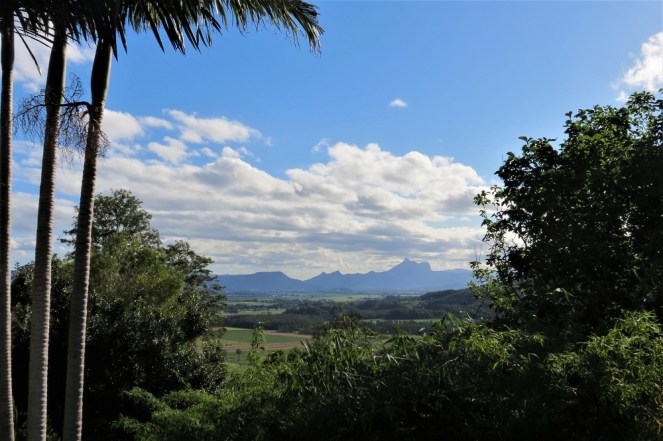
Today I made a point of taking a broader view photo of the mountain, showing the nearby palm trees. In yesterday’s post, I explained that we had lost a few lower leaves on our palms during the recent gusty storms. One significant leaf, which usually appears in my Mount Warning photos, is gone. Now when I take phtos of the mountain from this particular position in the garden, it feels like the photo isn’t complete – now I have to get used to a new normal!
The broad view photo adds context to the height of the palms, and why one very large drooping leaf always appeared in my camera lens. There is a bunch of seeds below the leaves on one palm, and the leaf that always appeared as an “extra” prop in my photos was growing between the leaves and the seed bunch.
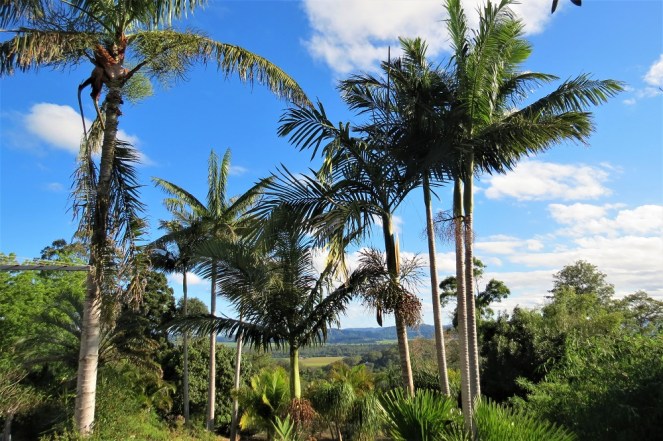
This next photo shows a different cluster of palm trees. Most of these trees – except for the one on the far left of the photo – are growing near the pool. As the lower leaves drop, new leaves are forming above, and adding height to the tree. Along the trunk of the tree, as each leaf drops it leaves a ridge in the trunk of the palm where the leaf once grew.
Surprisingly, palm leaves are incredibly heavy! When they crash to the ground they make a very loud sound, almost like thunder. The palm on the far left in the photo above has two leaves which could fall at any time. As the trees grow taller and the dying leaves are higher, we simply can’t reach them to cut the leaves down, so until they drop they look a tad messy dangling from the tree.

Every morning around sunrise, the kookaburras wait in the palm trees, keeping a watchful eye on the back door, waiting for me to go out and feed them. They rarely wait around the garden at night, probably because they know I won’t feed them. Tonight, however, I spotted one kookaburra sitting on my clothesline, watching the back door. What really struck me was the position of the bird in front of a gorgeous orange sunset.
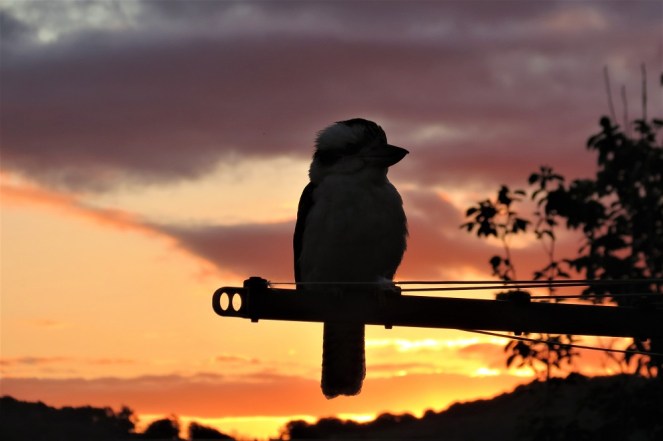
I rushed outside with my camera and took a few photos, and seeing as the kookie had been such a willing model, I made an exception and took a tiny treat out to him. I couldn’t decide which photo I liked best – the black silhouette, or the one that shows a glimpse of his features. So here are both photos. 🙂
 In My World