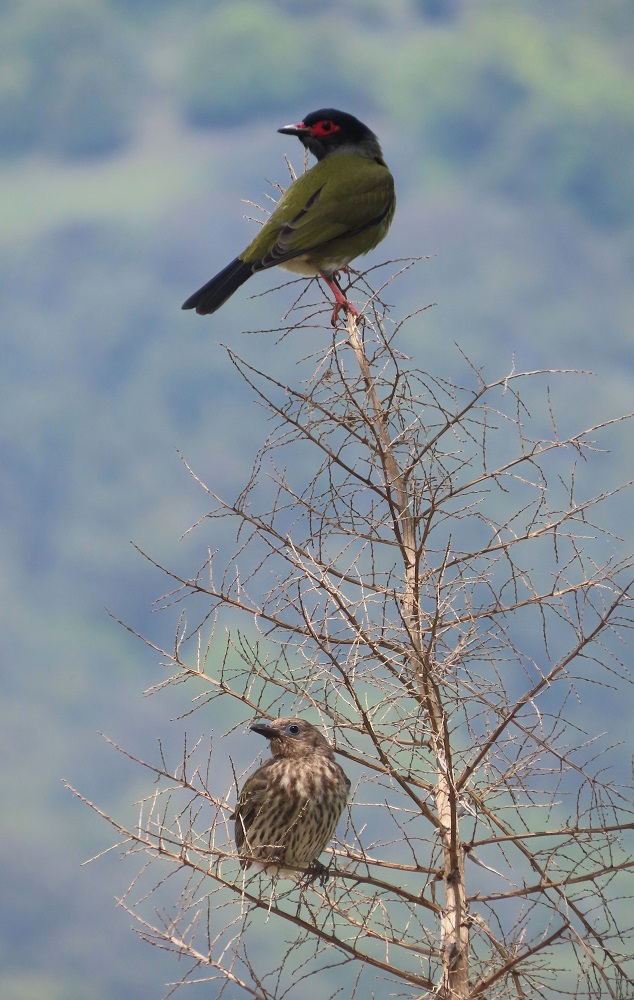
When my blogging friend, Barbara, added a post recently showing a brown thrasher bird, I commented on the similarities between the thrasher and a regular visitor to my garden, the figbird. Our figbirds are natives of Australia. The female, pictured above, has specked feathers not unlike the speckled breast feathers of the brown thrasher Barbara shared a photo of after spotting one during a walk In the Woods.

The male figbird, pictured above, looks like a different species of bird. Typical of many male bird species, they are the showier of the two with their olive green feathers and a distinctive red ring around their eyes.

I was fortunate enough to have a figbird “couple” perched on the finished flower of a ponytail palm this week, close to my window, so I didn’t need to zoom in too much to take photos of the pair.
The ongoing damp, humid weather we have had recently continued this week. Overnight, however, the weather seems to have righted itself and is now more consistent with the season. Today, the sun is shining, and the sky is a brilliant blue with hardly a cloud in sight. The temperature is also much higher today – nearly 32 degrees Celsius (or 89 Fahrenheit), yet the day feels cooler today than it did yesterday when the temperature was only 25 degrees Celsius, humid, and raining!

I couldn’t resist taking a photo of the valley today, on the last day of spring, with clearly defined slopes and crevices amid the mountain and ranges.
Dare I hope that those pesky mosquitoes will disappear now, along with the rain?


What a handsome fellow. You live in a beautiful place, Joanne. XOXO
LikeLiked by 1 person
Thank you, Stacy. 🙂
LikeLike
Such a lovely view!
LikeLiked by 1 person
It was so good to see it clear again!
LikeLike
What a beautiful picture of the figbird couple! It always amazes me that the males and females of some kinds of birds are so different but in other kinds of birds there is no way to tell them apart. Your female figbird does look remarkably similar to my brown thrasher, which looks the same for both sexes.
I hope your pesky mosquitoes did disappear with the rain. When we moved down south here we discovered the local TV weather people forecasting the number of mosquitoes out with their “Skeeter Meter.”
LikeLiked by 1 person
So do you have a problem with mozzies too, Barbara? Every creature on earth supposedly has its place, but I am yet to understand why mozzies exist!
There is probably some minute detail in the appearance of a thrasher that distinguishes male from female … if only you knew what that was! I am the same at trying to work out male from female kookaburras. On social media I often read the words of the learned ones, who explain it is something to do with the amount of blue colouring on their wings. Compared to what, I wonder … you need two, together, for comparison. But like people, no two birds of the same species look exactly the same anyway.
LikeLiked by 1 person
Very true, all those differences, some so slight and others striking and impossible to miss. I love that you call mosquitoes mozzies and we call them skeeters. 🙂 Nasty little things by whatever name!
LikeLiked by 1 person
Pretty birds and a gorgeous view!
LikeLiked by 1 person
When we can see the view, it is lovely. But it’s missing again, hiding somewhere behind the clouds today!
LikeLiked by 1 person
That male bird sure is handsome … often is the case with birds. Beautiful shot of the valley 😊
LikeLiked by 1 person
Thank you, Julie. ❤
Since summer arrived and the days are warmer, we have had some amazing sunsets over the valley. The view is ever-changing. 🙂
LikeLiked by 1 person