Today the weather was fine and sunny as far as I could tell. I spent most of the day indoors, at my desk, working on a uni assignment again. There were a few different birds in the garden when I went outside for a break, so I will let the photos do the talking today as I need to rest my tired eyes and mind. xx
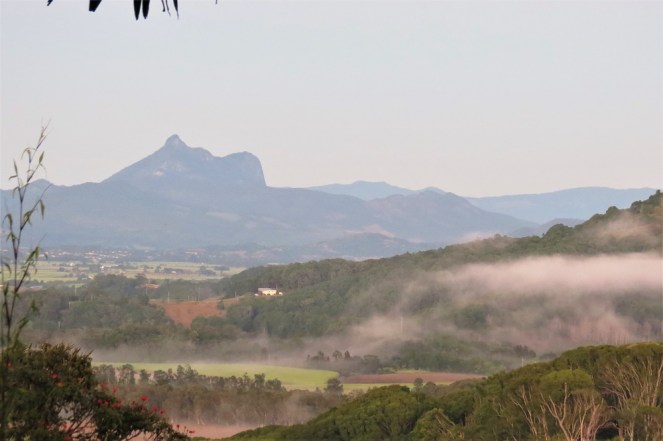
‘Twas another misty morning today. The mist wasn’t as thick as it has been recently, but it looked lovely all the same.
The mist sat in pretty pockets all through the valley, like a puffy layer of cotton wool blanketing the earth.
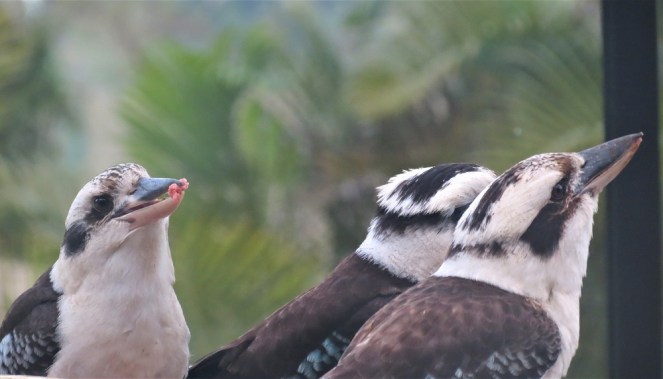
Another beautiful sight in the valley was a pair of kookaburras perched on a strong branch in a gum tree.
I completed a university assignment yesterday for the diploma course I started last year, the Diploma of Sustainable Living. I’ve been slotting a unit in here and there amid the Bachelor of Arts I started in second semester of 2017, and so far I’m coping okay. Units are often on offer during out-of-semester time slots, but this semester I’m studying one unit for the diploma and two for the BA, all at the same time.
The assignment I completed yesterday was for a unit I’m doing called Backyard Biodiversity. We were asked to choose one creature, be it birds, amphibian, mammal, or whatever else we may have seen in our yard, research the requirements for our chosen backyard buddy, then answer a series of questions for the assignment.
Any guesses on who I chose? 😉
The Laughing Kookaburra, (Dacelo novaeguineae) is a most interesting little character, which I already knew of course. But even I had a lot to learn about the habits of these gorgeous guys who visit my garden daily. I’ll add the information here straight from my assignment –
“Discuss the biological needs of your selected species:
For food, this species requires: worms, insects, lizards, snails, grasshoppers, small snakes, and unfortunately, amphibians. Kookaburras are carnivores, and also eat small mammals, rats and mice. They occasionally eat crustaceans. When larger items of food are caught, a kookaburra will bash their meal against a tree branch or on the ground to kill, or “tenderise” the food before eating it.
For shelter, this species requires: large eucalyptus trees with strong branches and natural hollows to shelter in. Kookaburras are family orientated and choose favourite trees in which to sleep together for approximately twelve hours each night. They often begin and end the day with a collective raucous chorus of “laughter”. In cold or wet weather, kookaburras huddle together for warmth in their chosen tree for lengthy periods of time.
For water, this species requires: clean water for drinking, although similar to owls, most of a kookaburra’s water requirement is obtained through their food. Being the largest members of the Kingfisher family, however, they enjoy bathing in water, therefore need to have access to water for this purpose.
For space, this species requires: a large area with plenty of eucalyptus trees. Kookaburras live in large, sociable family groups, they mate for life, and the dominant breeding pair of the group keep their young with them after reaching maturity to help tend future clutches. Kookaburras also occupy forests and woodlands, ideally where open ground areas offer clear visibility for spotting food. Kookaburras are territorial and their territory can cover several hectares of space, but they are respectful of other kookaburra families and will not encroach on spaces already claimed.
Other things this species requires are: safe retreats from predators. A main enemy of the kookaburra is domestic animals. During September to January, which is their breeding season, kookaburras also require a safe hollow in a tree which is large enough for the mother to lay approximately one to four eggs. Elevated termite mounds can also be hollowed out to build their nests in.”
I’ve always suspected the twelve kookaburras who visit my garden were one family, and now I can relate that information to my lovely visitors – my original visitor, who I named Larry, always came into my garden alone. After a while he brought along a little lady friend who I named Shilo. Those two kookaburras have learned to trust me, and I can now hand-feed both of them. They still visit.
Meanwhile, the family has grown. I had always wondered if other kookaburras had joined my original family from elsewhere, but from what I have read, Larry and Shilo are the dominant breeding pair, making all the rest siblings who remain with their family.
I also read that kookaburras are usually the first birds you’ll hear in the morning and the last you’ll hear at night. Just after finishing my assignment, I went out into my garden, and what did I hear? A collective chorus of kookaburras, laughing, right down the bottom of my garden! They may have a favorite tree just beyond my yard, but the were close. With my new-found understanding of their habits, hearing the kookaburras last night, right on nightfall when there were no other bird-sounds to be heard, I felt privileged to know they were so close, and that they had chosen a “favourite” tree to rest in so close to my home.
I have also learned this week that kookaburras were seen by the early settlers in Australia, and were noted as a species of bird they had never seen before. In 1788, the kookaburra was identified as a “Giant brown Kingfisher”. I found this information in a book I just bought called Journals of the First Fleet, which is the journal entries of Captain Arthur Phillip and Lieutenant General Watkin Tench, who both arrived in Australia with the first fleet of convicts, brought here to settle on our shores. Many of these convicts, mainly from England and Ireland, are the ancestors of Australia’s current inhabitants.
1788 drawing of a kookaburra.
The drawing depicts details of the Great brown Kingfisher which we can easily identify as our Laughing Kookaburra. And here is the information accompanying the picture, and written in the 1788 journal …
Isn’t it strange to think we see the very same birds species today, even sounding the same, as they did back in 1788? Barbara spoke about this concept in her post The Continuation of Life. Since I read Barbara’s post, the thought has remained with me, and every now and then I try to drag past situations into the current age. I have also tried to “see” things from the point of view of people who lived 200 years ago. I don’t believe it is possible to understand what life was like for people living so many years ago, nor do I believe it is fair for us to place judgements on them based on the values we have today. Yet my contemplations have made people of the past seem more “real” somehow, although that’s another concept that is difficult to explain. Of course they are real! But it is difficult to imagine them as real because we didn’t know them.
I wonder if that is why lately people the world over are showing so little respect for people of the past? You know the people I mean, those who are trying to rewrite history books and smash statues that are there to honour the achievements and sacrifices people of the past made in an effort to forge a better world for future generations.
It is not for us to judge the decisions made by people who lived so long ago. No one can change the past, and as life continues, so different to the way it was 200 years ago, I find it comforting to realise that those early settlers heard and saw the same Laughing Kookaburras that I admire every day in my garden.
Just the tiniest, flimsiest wafts of mist danced around the valley this morning.
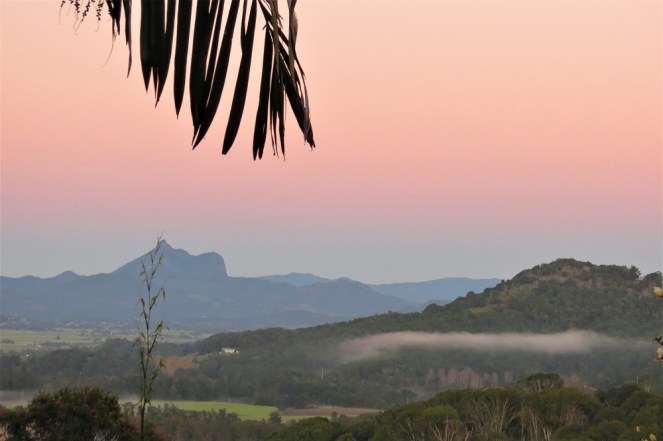
Before sunrise Mount Warning looked a tad grey, even the sky was grey. Then the sun peeked over the hill and lit up the morning sky.
What a difference a few minutes makes early in the morning!
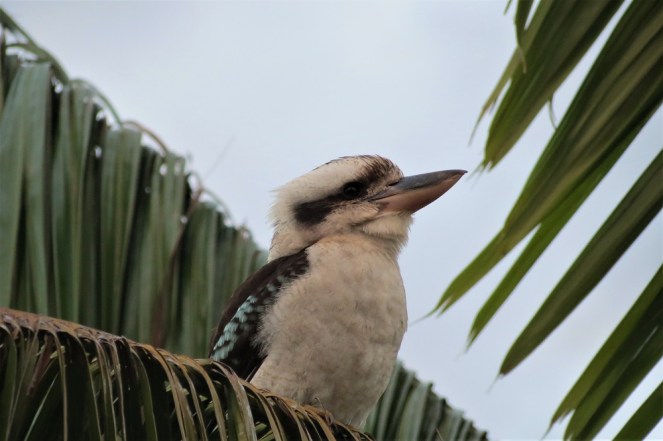
I’m sure kookaburras enjoy the attention, because it seems that every time I venture outside with my camera lately, I find a little poser nearby. This little guy struck a pose on the top of my clothesline.
“Would you like a closeup of my profile? I think this is my best side …”
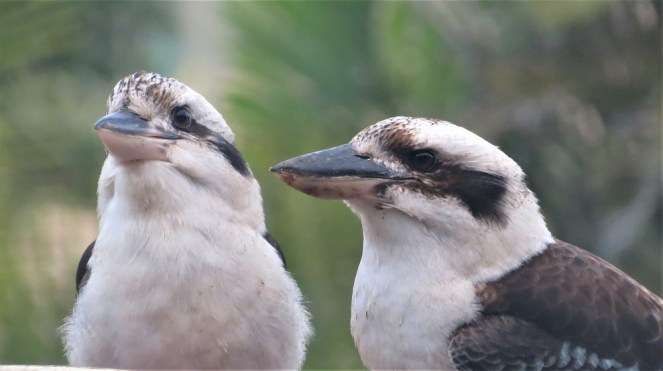
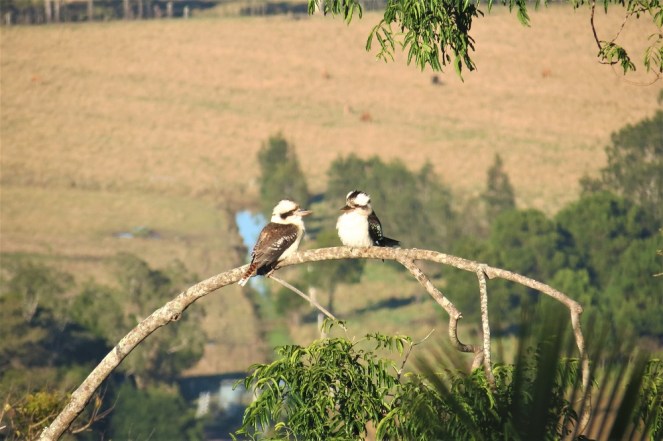
I can’t resist taking photos of the kookaburras I see perched on a tree down towards the valley. There were two on the branch this morning.
There are so many flowers blooming in my garden right now, even though we are in the middle of winter here in Australia.
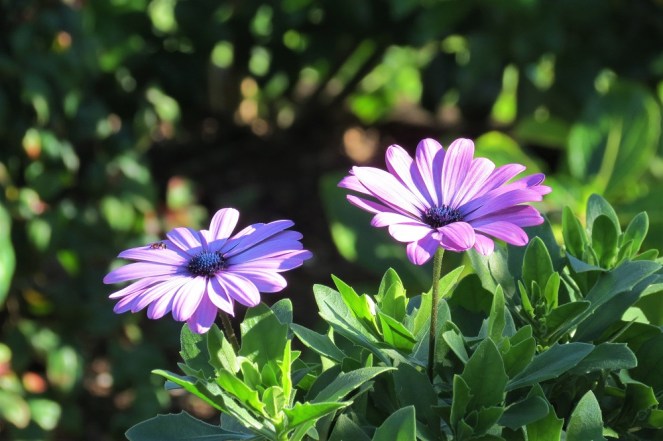
The daisies look gorgeous right now, dancing in the sunshine.
There are only a few gazanias, but the yellow always looks so bright and summery, even in the depths of winter.
Did I say depths of winter? Our weather just now is probably similar to what some countries experience during summer! It’s a beautiful time of year.
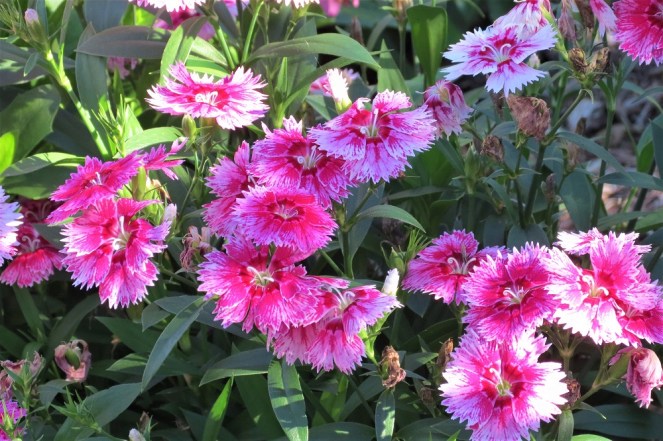
My pink dianthus bloom nearly all year round.
When I saw this butterfly, which I believe is a male Common Eggfly, flitting around the daisies, I suspected it would fly away before I had a chance to get a decent shot – but it didn’t! I’m pretty excited to get my first decent photo of a butterfly in my garden. There’s another photo of him on yesterday’s Wordless Wednesday post too, with his wings open.
The day began so incredibly dull that I thought we were in for more rain.
After the magnificent colour show yesterday morning, this morning Mount Warning looked bleak and one-dimensional. The valley still looked pristine and clear after being washed by the weekend rain, as did the mountain and ranges, but there was nothing outstanding to take a photo of.
Dare I say, after the brilliant colours of yesterday, the mountain appeared … well … boring?
By sunset though, the mountain did not disappoint any longer. The clouds absorbed the colours of the sun and put on a beautiful show in the sky.
To be completely honest, I was not at all disappointed by the mountain. To me, it is always beautiful and magical. I love the way the mountain dominates both my garden and the whole of the Tweed Valley. But now I’m committed to sharing a photo of my beloved mountain each day I want to show her at her spectacular best.
Perhaps I’m setting my standards a tad too high!
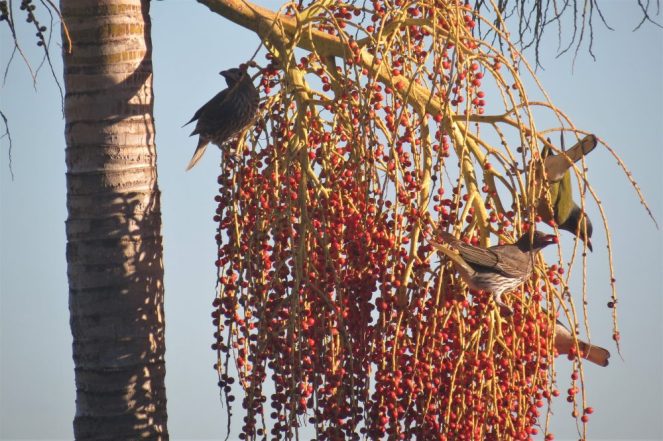
I had a flock of figbirds visiting today. The bunch of palm seeds they are feeding on are at the top of one of our palm trees, so the photo is taken on full zoom. Unfortunately the birds aren’t as clear as they would be if they were closer, but I still love to see them munching on the red berries. The bird on the far right of the photo with his nose down is a male figbird and the two other birds with the mottled feathers are females.
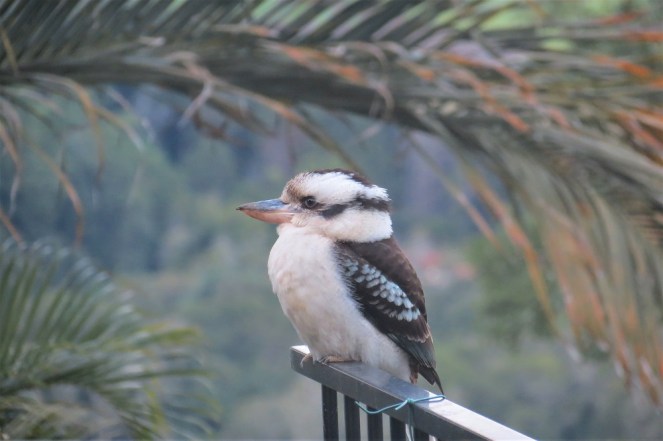
One bird I can always rely on to come close enough for a clear photo is a kookaburra. They seem to have a knack of posing in just the right place for me to take a photo with a lovely background.
The view to Mount Warning and across the Tweed Valley this morning looked incredible. A thick layer of mist had settled in the valley overnight, hiding from sight every object – both natural and constructed – that is usually visible on the valley floor. I took a series of misty morning photos which I will post here tomorrow.
Yesterday, my husband and I spent the day in our garden, right down the back of our yard among the fruit trees we planted several years ago. We’ve had a pretty hectic past eighteen months for one reason or another and have consequentially neglected our orchard area. And it shows. We have lost a couple of trees and have pruned back others harshly, hoping they will bounce back after some care and attention.
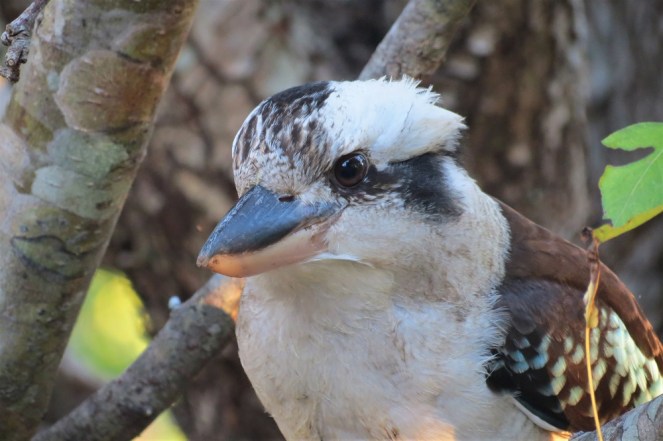
We were not alone in the garden though. As we were digging around our (very healthy!) pecan tree we noticed a kookaburra watching us from its perch in the pear tree.
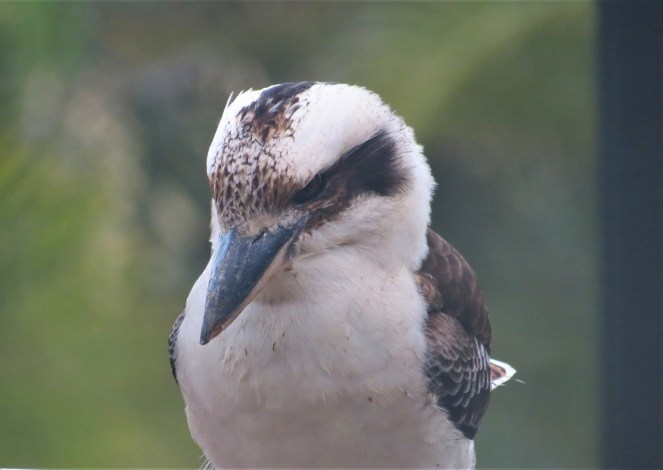
You might notice the intensity of this gorgeous bird’s gaze! We knew what he was looking for – dinner – and it wasn’t long before he swooped down to catch a tasty morsel he had noticed in the soil.
At other times he seemed quite nonchalant, as if the potential of discovering a meal in our turned garden soil hadn’t crossed his mind!
After collecting dinner he flew back to the tree branch and dined alone, then shortly after he flew away.
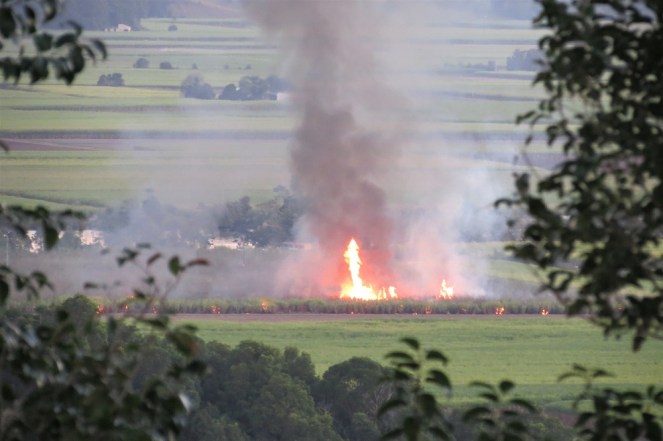
Meanwhile, we heard the crackling sound of a sugar cane fire starting in the valley.
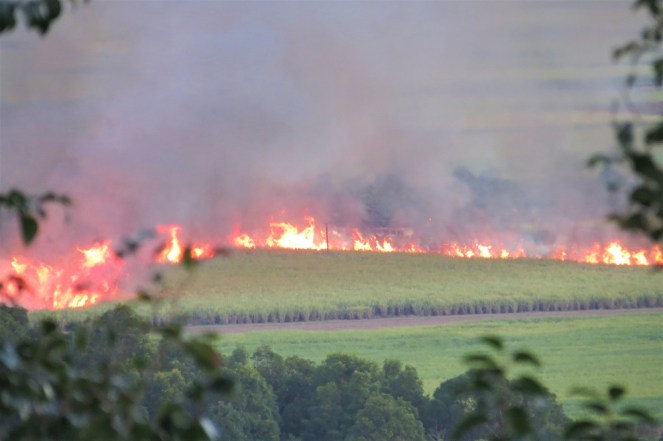
The fire was just a short distance away from our yard, but far enough away from the sudden drop at the end of our yard to be able to see the cane fire clearly. As the fire burned, I took a series of photos.
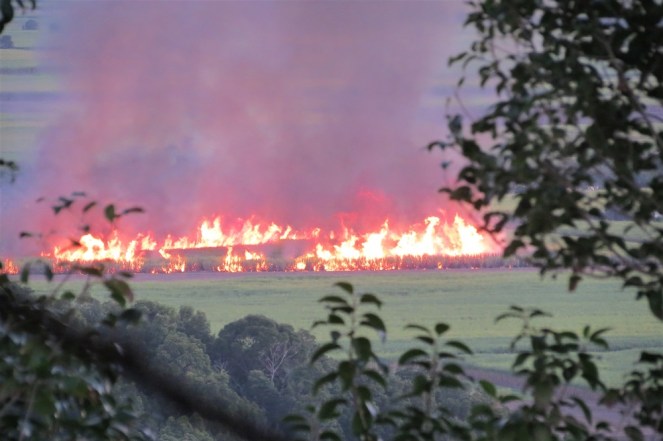
The outer perimeter of the cane field is clearly outlined, and as you can see the fire has been lit around the perimeter. The flames quickly gain momentum, burning the inner section of the field to remove leaf debris before harvesting can take place.
Within an incredibly short time, the fire is over. The job is done.
The time between the last two photos is just two minutes.
Just one minute later, the flames are virtually gone.
From the first dim sound we heard as the cane fire began, to the time the flames were gone, just ten minutes passed.
The sugar cane industry has played an integral role in the Tweed Valley for many generations. Newcomers to the area often cannot understand the attraction locals have to seeing cane fields ablaze every winter, but to the long-standing locals like myself, and to my husband – a fourth-generation Tweed local – the area simply would not be the same without the familiar orange glow in the valley each winter.
















 In My World