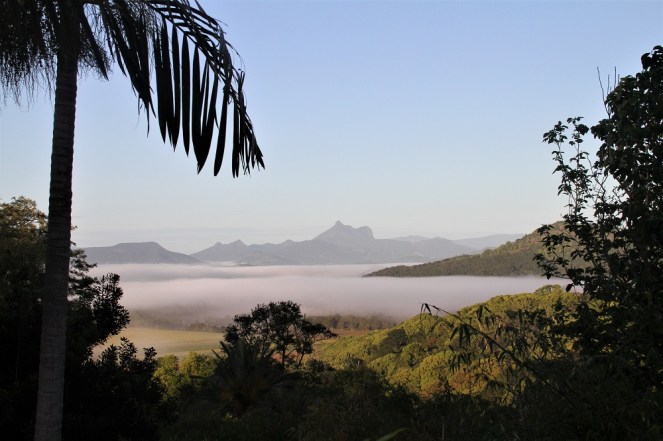
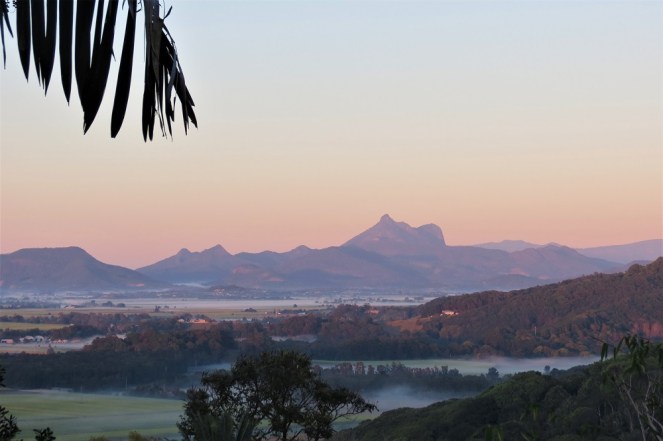
A beautiful sight welcomed me this morning when I looked out into the valley. After a relatively warm night I had not expected to see mist, but there it was, dancing ghost-like across the valley and looking spectacular.
We’ve had a fair bit of rain over the last few days, so my theory is that when the warmer air hit the cold earth, condensation rose in the form of mist. Does that sound logical? It’s the same when you get into a cold car with your warm body and breath, and the windows fog up and you have to put on the demister, I imagine.
Whatever caused the mist, I hope it happens again before summer arrives. 🙂
There was mist in the valley again this morning. Now the weather is warming up I will probably see fewer misty mornings, so I can’t resist taking photos of the effects of cooler weather while they last.
We had an arborist here today, cutting back some trees and trimming the high branches off others. The area he worked on is right down the back of our property along the back boundary. So later this afternoon, after he left, my camera and I took a walk down there to see what we could see now.
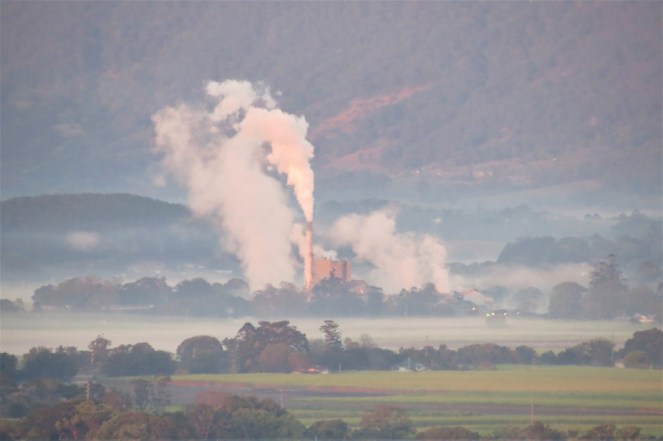
Besides a magnificent, uninterrupted view across the valley, there was a sugar cane fire way off in the distance, which I hadn’t noticed from the house. Just slightly to the left of the lower centre of the photo above there are previously burned blackened cane fields, which will turn green again in no time at all. To the right of the black fields are plenty of green cane fields still awaiting harvest.
By the time I arrived back at the house the sun was setting. The sky had just a hint of orange and looked very pretty.
So today is officially the last day of winter in Australia. The temperature reached 26 degrees Celsius, so it was definitely not a cool day! We could still have a few cooler days, but from now on the warmer days will become more frequent than cooler days. It’s a beautiful time of year now, but I’m really not looking forward to the humidity of summer at all! I complain about the heat every year though, and each year I try to find things to enjoy during the summer months. This year will be no exception.
Oh, and I had one of my regular visitors drop by around sunset as well. 🙂
Against the odd, I woke up just in time to see the sunrise this morning.
And what a treat to also see transparent layers of mist laying across the fields of sugarcane as well!
When we moved into our new home twenty-six years ago, a friend described our view over the valley as the perfect setting for Lord of the Rings. I still haven’t read the book, but I have just started reading The Hobbit. So far I have only read three chapters, so I will be looking out for any descriptive passages that aptly describe our view of the valley. I’ll let you know if I find any.
I finally finished the assignment I have been working on this week and submitted it late this morning. After lunch, I spent the afternoon at the computer catching up on other study. Next week, I have a week off for mid-semester break, but I have two more assignments due in two week’s time, so I will be working on those during the break.
Two week’s ago I shared some photos and detailed information about kookaburras. I had been researching for an assignment and chose the kookaburras as I feel an affinity with them, especially my two old regulars, Larry and Shilo. My results came back today – 98/100 – so I’m pretty pleased about that. 🙂
That’s all for today. It’s been another long day at the computer and I’m heading off to bed. xx
‘Twas another misty morning today. The mist wasn’t as thick as it has been recently, but it looked lovely all the same.
The mist sat in pretty pockets all through the valley, like a puffy layer of cotton wool blanketing the earth.
Another beautiful sight in the valley was a pair of kookaburras perched on a strong branch in a gum tree.
I completed a university assignment yesterday for the diploma course I started last year, the Diploma of Sustainable Living. I’ve been slotting a unit in here and there amid the Bachelor of Arts I started in second semester of 2017, and so far I’m coping okay. Units are often on offer during out-of-semester time slots, but this semester I’m studying one unit for the diploma and two for the BA, all at the same time.
The assignment I completed yesterday was for a unit I’m doing called Backyard Biodiversity. We were asked to choose one creature, be it birds, amphibian, mammal, or whatever else we may have seen in our yard, research the requirements for our chosen backyard buddy, then answer a series of questions for the assignment.
Any guesses on who I chose? 😉
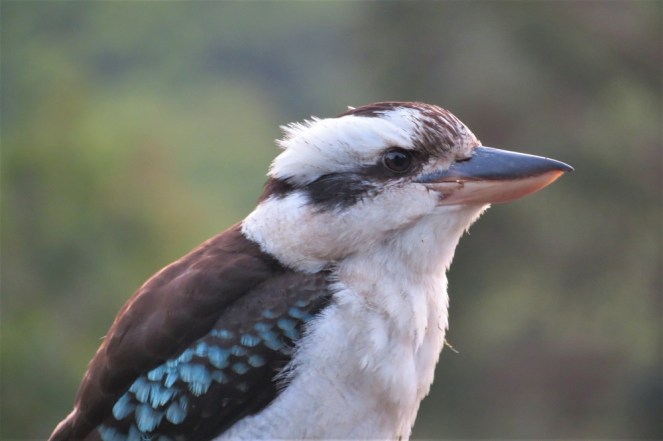
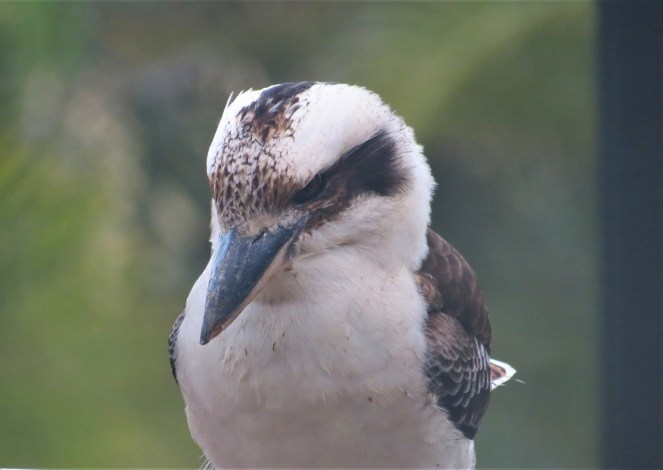
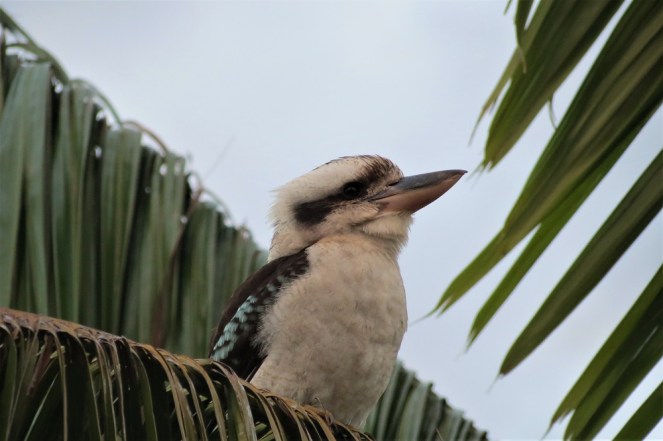
The Laughing Kookaburra, (Dacelo novaeguineae) is a most interesting little character, which I already knew of course. But even I had a lot to learn about the habits of these gorgeous guys who visit my garden daily. I’ll add the information here straight from my assignment –
“Discuss the biological needs of your selected species:
For food, this species requires: worms, insects, lizards, snails, grasshoppers, small snakes, and unfortunately, amphibians. Kookaburras are carnivores, and also eat small mammals, rats and mice. They occasionally eat crustaceans. When larger items of food are caught, a kookaburra will bash their meal against a tree branch or on the ground to kill, or “tenderise” the food before eating it.
For shelter, this species requires: large eucalyptus trees with strong branches and natural hollows to shelter in. Kookaburras are family orientated and choose favourite trees in which to sleep together for approximately twelve hours each night. They often begin and end the day with a collective raucous chorus of “laughter”. In cold or wet weather, kookaburras huddle together for warmth in their chosen tree for lengthy periods of time.
For water, this species requires: clean water for drinking, although similar to owls, most of a kookaburra’s water requirement is obtained through their food. Being the largest members of the Kingfisher family, however, they enjoy bathing in water, therefore need to have access to water for this purpose.
For space, this species requires: a large area with plenty of eucalyptus trees. Kookaburras live in large, sociable family groups, they mate for life, and the dominant breeding pair of the group keep their young with them after reaching maturity to help tend future clutches. Kookaburras also occupy forests and woodlands, ideally where open ground areas offer clear visibility for spotting food. Kookaburras are territorial and their territory can cover several hectares of space, but they are respectful of other kookaburra families and will not encroach on spaces already claimed.
Other things this species requires are: safe retreats from predators. A main enemy of the kookaburra is domestic animals. During September to January, which is their breeding season, kookaburras also require a safe hollow in a tree which is large enough for the mother to lay approximately one to four eggs. Elevated termite mounds can also be hollowed out to build their nests in.”
I’ve always suspected the twelve kookaburras who visit my garden were one family, and now I can relate that information to my lovely visitors – my original visitor, who I named Larry, always came into my garden alone. After a while he brought along a little lady friend who I named Shilo. Those two kookaburras have learned to trust me, and I can now hand-feed both of them. They still visit.
Meanwhile, the family has grown. I had always wondered if other kookaburras had joined my original family from elsewhere, but from what I have read, Larry and Shilo are the dominant breeding pair, making all the rest siblings who remain with their family.
I also read that kookaburras are usually the first birds you’ll hear in the morning and the last you’ll hear at night. Just after finishing my assignment, I went out into my garden, and what did I hear? A collective chorus of kookaburras, laughing, right down the bottom of my garden! They may have a favorite tree just beyond my yard, but the were close. With my new-found understanding of their habits, hearing the kookaburras last night, right on nightfall when there were no other bird-sounds to be heard, I felt privileged to know they were so close, and that they had chosen a “favourite” tree to rest in so close to my home.
I have also learned this week that kookaburras were seen by the early settlers in Australia, and were noted as a species of bird they had never seen before. In 1788, the kookaburra was identified as a “Giant brown Kingfisher”. I found this information in a book I just bought called Journals of the First Fleet, which is the journal entries of Captain Arthur Phillip and Lieutenant General Watkin Tench, who both arrived in Australia with the first fleet of convicts, brought here to settle on our shores. Many of these convicts, mainly from England and Ireland, are the ancestors of Australia’s current inhabitants.
1788 drawing of a kookaburra.
The drawing depicts details of the Great brown Kingfisher which we can easily identify as our Laughing Kookaburra. And here is the information accompanying the picture, and written in the 1788 journal …
Isn’t it strange to think we see the very same birds species today, even sounding the same, as they did back in 1788? Barbara spoke about this concept in her post The Continuation of Life. Since I read Barbara’s post, the thought has remained with me, and every now and then I try to drag past situations into the current age. I have also tried to “see” things from the point of view of people who lived 200 years ago. I don’t believe it is possible to understand what life was like for people living so many years ago, nor do I believe it is fair for us to place judgements on them based on the values we have today. Yet my contemplations have made people of the past seem more “real” somehow, although that’s another concept that is difficult to explain. Of course they are real! But it is difficult to imagine them as real because we didn’t know them.
I wonder if that is why lately people the world over are showing so little respect for people of the past? You know the people I mean, those who are trying to rewrite history books and smash statues that are there to honour the achievements and sacrifices people of the past made in an effort to forge a better world for future generations.
It is not for us to judge the decisions made by people who lived so long ago. No one can change the past, and as life continues, so different to the way it was 200 years ago, I find it comforting to realise that those early settlers heard and saw the same Laughing Kookaburras that I admire every day in my garden.
Whenever you are creating beauty around you, you are restoring your own soul. ~~ Alice Walker.
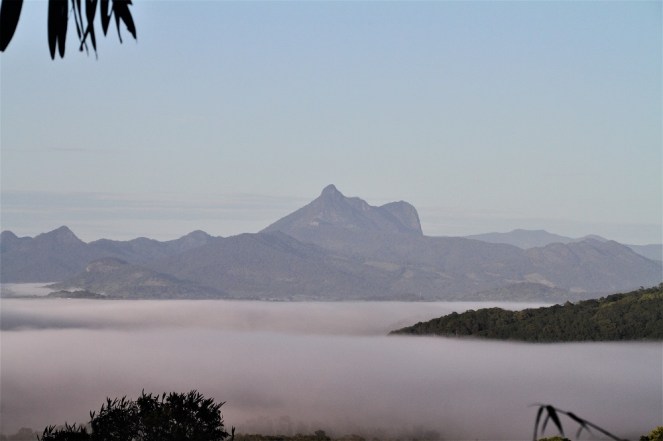
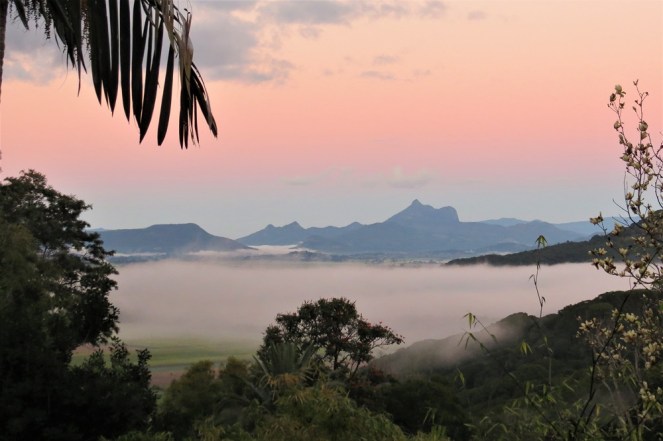
When I read this quote from Alice Walker it resonated with me. I love having beautiful things around me, and when I see Mount Warning rising above a valley filled with fluffy white mist before sunrise, it makes my heart sing. Even though I didn’t “create” this beauty, I can take photos to virtually make the beauty last longer than nature intends it to.
When the sun shone on the mountain it glowed and glistened in the sunlight. The photo doesn’t do it justice. I’ve seen this glowing effect before when there’s mist in the valley, so I suspect it has something to do with the sun’s rays reflecting – or deflecting? – on both the mountain and the mist. Or maybe the clouds play a part in creating the glow. I’m not sure.
While the mountain and mist created their magic this morning, a pair of Figbirds feasted on the red palm berries. The early morning light of the day made it possible for me to take a cute silhouette photo of a Figbird with one of the berries.
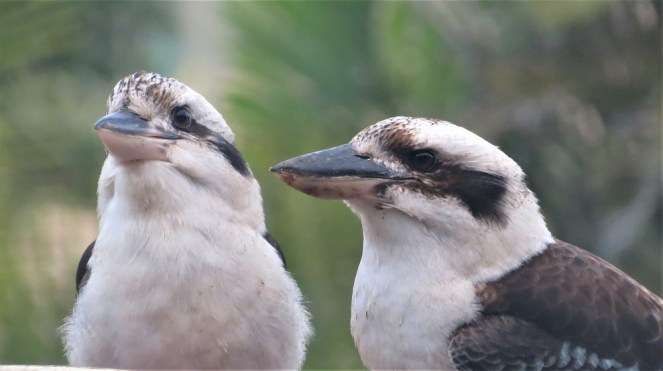
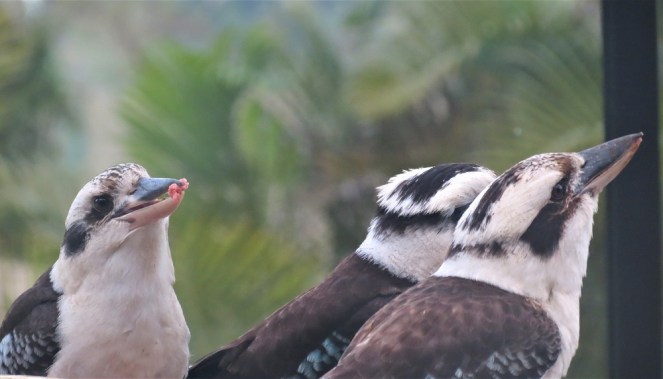
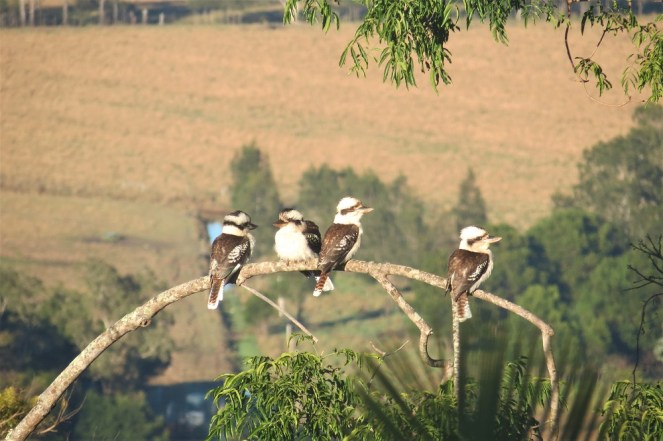
This last photo of four kookaburras is from yesterday morning. I know there are about one dozen Kookaburras in my area, but only four are visiting regularly just now. I’m hoping that means the mama birds are busily tending their nests. If that’s the case, I may have some fluffy young Kookaburras visiting my garden by summer. I hope so.
So that was my “soul restoring” activity for this morning, taking photos of the beautiful view from my garden to share with my bloggy friends. No wonder I enjoy blogging so much and miss it when I’m away from it for too long. 🙂










 In My World