Australia · Changes · new

Over the Border ~ Kirra Point Lookout, Queensland.

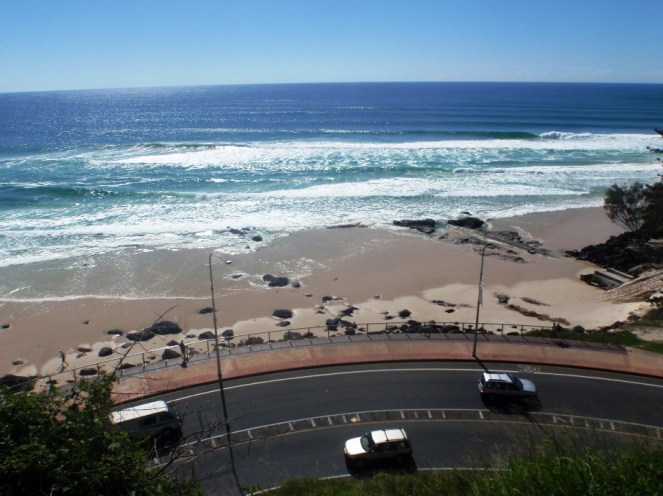
The road below...

After weeks and weeks of less than perfect weather, it is so wonderful to finally see days on end of nothing but the sun! The weather has cooled down dramatically and everything is looking pristine and sparkly.

I paid a visit to Kirra Point Lookout the other day, knowing I had the perfect weather for taking some great photos of the ocean.

From the lookout to the north is Kirra Beach, usually jammed packed full of surfers. Kirra Beach is world-famous for its surfing conditions. In fact, it was at Kirra that the second Surf Life Saving Club was established in Queenland, at a meeting held on January 7th 1916, with the Coolangatta Surf Life Saving Club, established in 1911 being the oldest in the state.

As you can see here, Kirra Beach was almost deserted. Perhaps the surfing conditions were not as they should be, even on the sunniest of days…
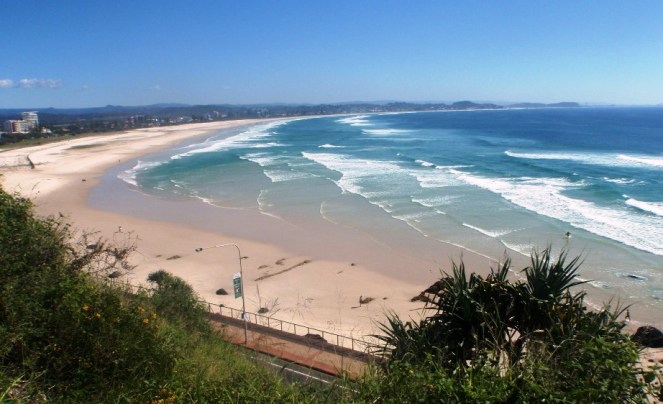
Kirra Beach

Coolangatta Beach too, to the south of the lookout, was all but deserted.

...and Coolangatta Beach

I loved the blueness of the sky as a backdrop for this white apartment building in Coolangatta.

White on blue

Over the last twenty-five to thirty years a number of older style beachside apartment buildings have been demolished, in favour of these multi-story apartment buildings and holiday units.

Tall buildings against the sky.

A monument of a large iron eagle, with the appearance of it soaring through the air towards the ocean, has been erected at Kirra Point Lookout. Whilst it is very interesting to see the iron eagle, I don’t know the significance of it.

Ready to soar out across the ocean...

I wonder if there is a significance, or whether someone simply liked the idea?…I’ll keep asking around.

The iron eagle, in perspective to the lookout.

Whilst I stood at Kirra Point Lookout, clicking away in this direction and that with my camera, I spotted an old church, nestled beside some other buildings, up on a hill in the distance at Coolangatta.

A different scene, something old, amid the new.

It started me thinking and casting my mind back to the Tweed Heads and Coolangatta area that I first knew, back in the days before the new apartment buildings and holiday lets were constructed.

How many old buildings remain in the area?

The weatherboard holiday lets along the beach – gone, and replaced with highrise buildings.

The row of shops containing two cinemas – gone, and replaced with a multi-level shopping centre, office space and one new cinema.

An old roller skating rink ~ gone, and replaced by a car park.

The original lighthouse at Point Danger ~ gone, and replaced by the Captain Cook Memorial Lighthouse.

I have decided that, by and large, Australians are an unsentimental (is that a word?) race of people and prefer to re-built rather than refurbish and extend!

Anyway, yesterday I took myself off to the old church on the hill and took a number of photos. I found another church of a similar vintage just around the corner also, but have yet to find any other old buildings in this area!

Next post, I’ll share with you my two old churches, (and any other old buildings I may come across in the meantime, if they exist!)


Australia · autumn · The Week That Was

The Beauty in Dull Weather Days

About a month ago I joined a website called Blipfoto, which I was introduced to by Kathy at “Reinventing the Event Horizon”. Kathy’s partner Sara, a wonderful photographer, had discovered Blipfoto and joined the site herself, and Kathy invited everyone to drop by Sara’s Blipfoto site.

Surfing fanatics don't care about the weather, just the waves.

Initially my plan was to take a look at Sara’s photos and offer her my support, although five minutes later I had joined the site myself and was contemplating my first photo!

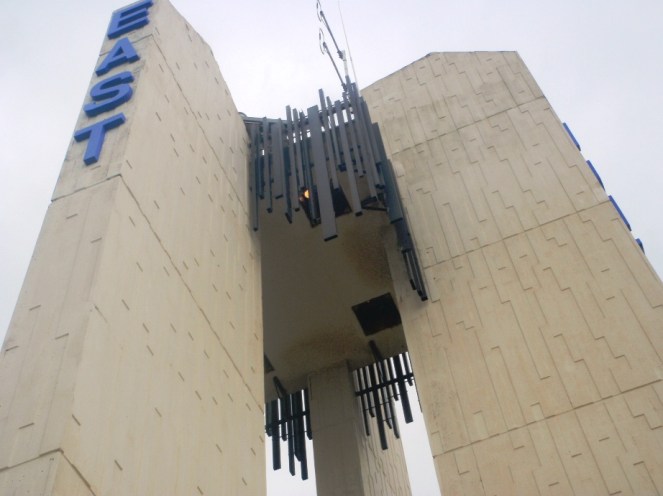
Looking out from the Captain Cook Memorial Lighthouse at Point Danger.

The decision was a no-brainer really; any site recommended by Kathy and Sara had to be worthwhile, I had admired Sara’s photos on Kathy’s site for some time, and, although I am a novice photographer myself, I have become increasingly interested in the technicalities of photography myself over the past couple of years.

Looking up at the lighted area.

Blipfoto allows the posting of one photo per day, accompanied by a small description of said photo, although not absolutely essential. I find this extremely achievable, even on the busiest of days.

A closeup of the Lazerbeam Lighthouse.

In the process of taking just one photo for each day, however, I am ending up with at least ten new photos each day, and after choosing “the one” for the day, the rest of my photos, however amazing, must be resigned to a life in my desktop folder of photos…..

Duranbah Beach, still busy, even on a wet day.

…..unless ~ I show some of my favourites here!

A dull day at Elephant Rock, Currumbin, Queensland.

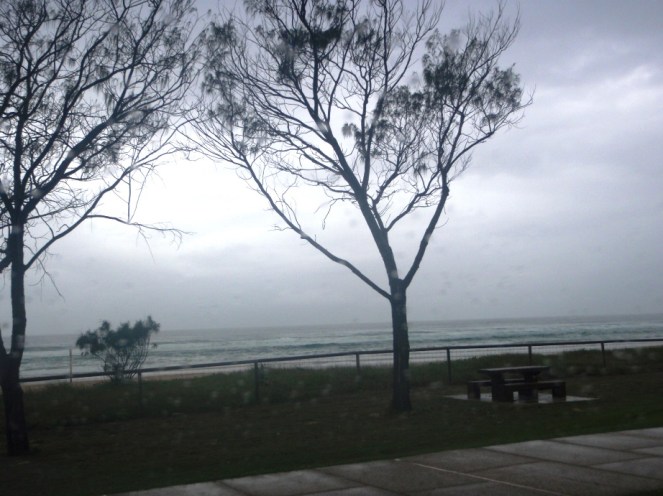
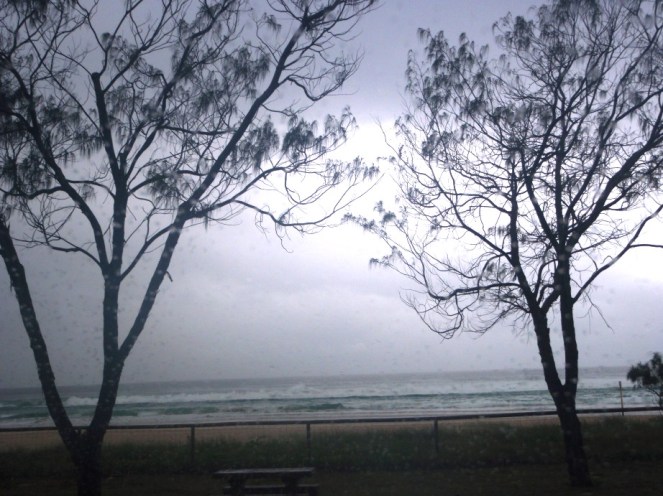
In reality, the weather here during the past week has been nothing spectacular, unless you enjoy rain and dull days. Some of my photos have even been taken from inside my car, in an effort to keep dry and I have been surprisingly pleased by some of the results.

An almost empty car park area at Currumbin Beach.

When the sky is cloudy and grey, the lighting effect on the photos is different to that of a sunny day and I find that there is a certain beauty in photos taken on cloudy days.

Currumbin Beach

Perhaps there has even been a name invented for this white/grey effect, I’m not sure.

Gloomy, yet beautiful.

“The Week That Was” may even become a regular end-of-week post here, if I keep on taking photos worthy (to me, at least!) of being displayed.

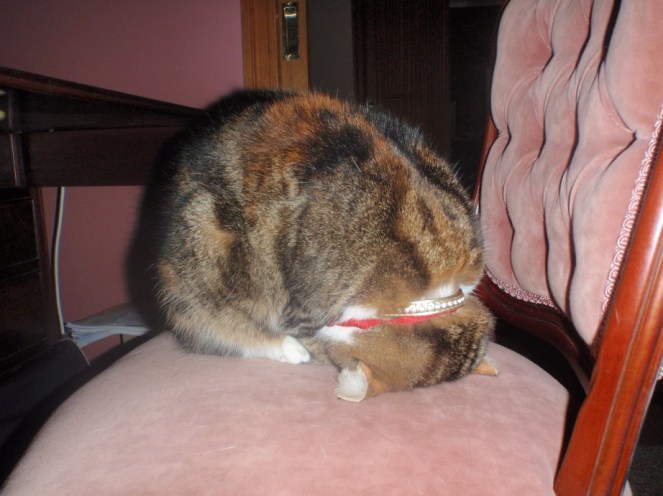
This photo made it to Blipfoto; my funny little Cutie, confined to the "great indoors"!


Australia · autumn · Mount Warning · Tweed Valley

Towns of the Tweed ~ Fingal Head (Part 2) A Volcanic Rock Headland

In May 1770, when Captain James Cook sailed along the eastern coast of Australia, he originally named what is today known as Fingal Head, Point Danger. Today, Point Danger is located just five kilometres north of Fingal Head. Since the mistake of locations was made so many years ago, the two place names have become established in the area, and are not about to be changed, even to keep Captain Cook happy!

Cook Island from Fingal Beach

Regardless, both Point Danger and Fingal Head are points of immense natural beauty in the area and both also share the need for a lighthouse, due to the dangerous offshore reefs.

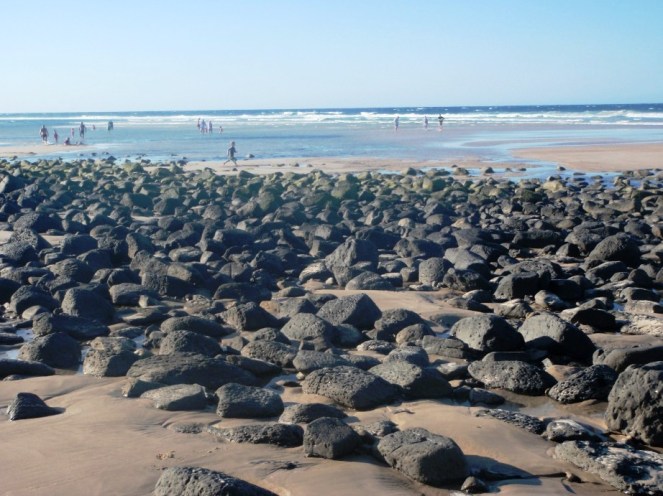
Heading along the beach to the wall of volcanic rocks.

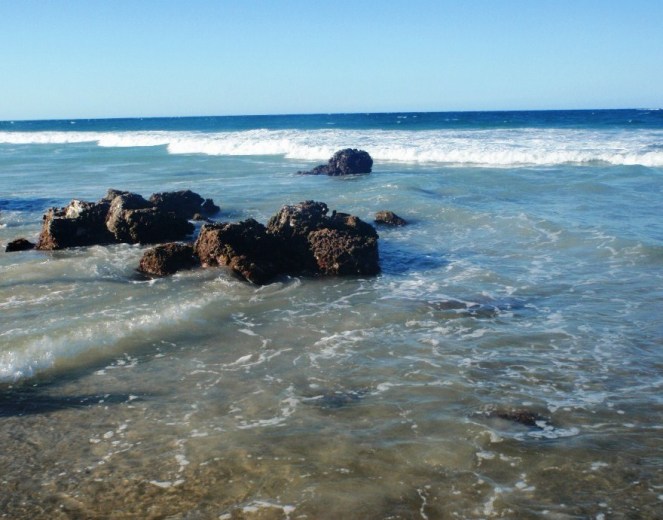
When my husband and I spent a leisurely Sunday afternoon at Fingal Beach recently, the dangerous reefs and pounding waves were the least of our concerns. We took a long walk along the sandy beach, dodging the volcanic rocks, as my ex-surfer and fourth generation Tweed Valley husband educated me on the history of the beach, pre-Cook days.

Volcanic rocks, untouched, after so many years.

About twenty-million years ago Mount Warning, (you will remember Mount Warning, surely, from the umpteen times I have made mention here of this Magical Mountain) a now-extinct volcano, spat out basalt lava, now hardened into rocks, which to this day adorn the shores of Fingal Beach.

There's plenty of beach beyond the rocks.

Surely these rocks haven’t remained here, on this same beach, for twenty-million years, untouched, I wondered? Apparently, yes, they have. The basalt lava from Mount Warning solidified and over the years has transformed into the rock formations we see today on the beach.

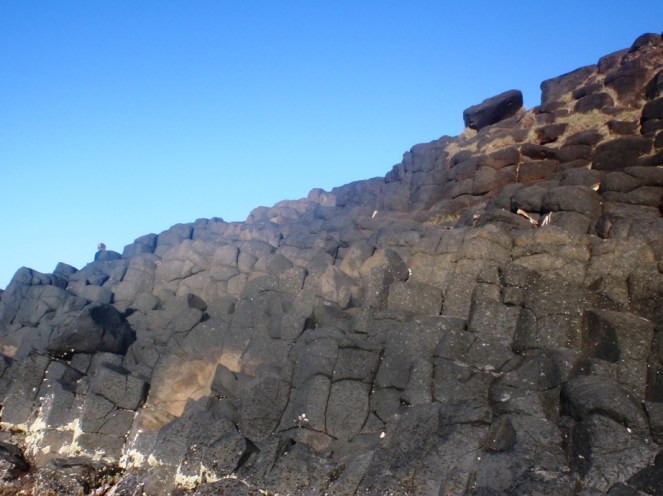
Basalt lava, cooled over 20 million years, and split into columns of rock.

As the lava cooled and contracted, in places it split into unusual columns of rocks, which resemble rock formations in Fingal, Ireland, hence Fingal Head was given its name.

The rocky cliffs which lead to the lighthouse.

We climbed over a narrow section of the rocks to reach a grassy, tree-lined track, which would take us up to the Fingal Lighthouse.

At the top of the embankment, Fingal Head Lighthouse was there to greet us.

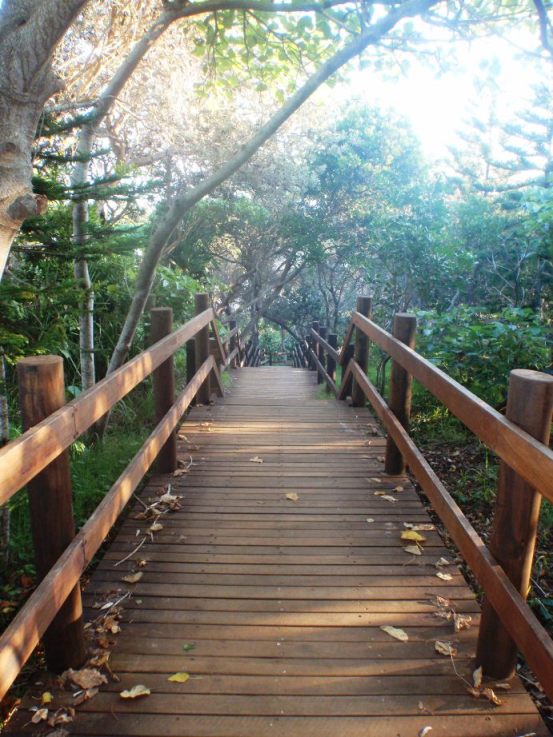
After quite a considerable amount of time spent photographing and admiring Fingal Head Lighthouse, we ventured along the boardwalk tracks, not knowing for sure where they would lead to.

The boardwalk.

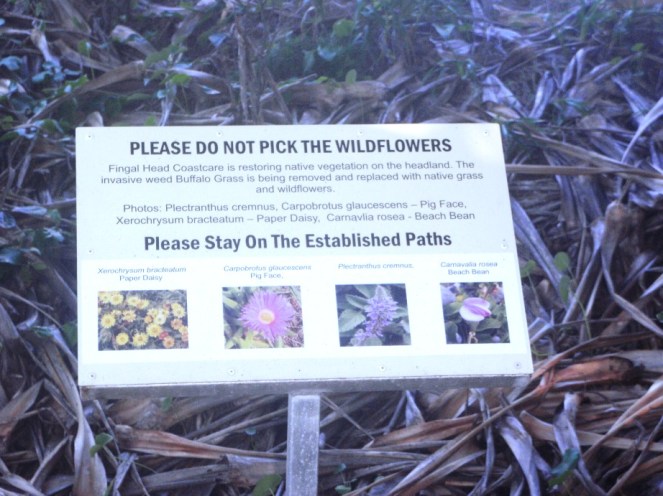
After surviving over twenty-million years subjected to the elements, it is good to know that the area is being taken care of, in an effort to retain the natural beauty of Fingal.

The conservation of the flora, fauna and history of Fingal is now in the hands of those who care.

There were a number of off-shoots along the path but we chose the path which would lead us back to the beach.

This pretty shell in the sand provided me with a new header for this page!

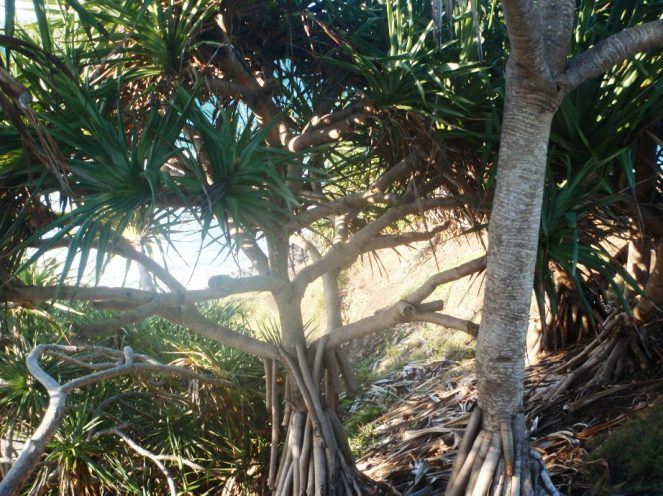
I’m not sure of the name of the trees around the beach, but look at the unusual roots in this next photo. I thought at first that the soil, or sand, had eroded from around the base of the trees, leaving the roots exposed, but my husband assures me that is the way these trees grow.

These trees were everywhere, along the beach and around the lighthouse.

As we headed back towards our car, I glanced back for one last look at the volcanic rocks along the beach, and noticed how long the shadows were getting as night-time approached.

Aren't we tall?

It really was a picture perfect day, with the brilliant blue skies are gentle breeze. Even as the sky darkened, everywhere I looked I found more and more beautiful images to photograph, as we bid our goodbyes to Fingal Beach.

Goodnight Fingal. 🙂
Australia · autumn · Mount Warning · old house · Tweed Valley

Towns of the Tweed ~ Fingal Head (Part 1) The Tiny Lighthouse Watching Over the Huge Ocean.

When my children were little people who loved having a bedtime story read to them each night, one of their favourite books was called “The Most Scary Ghost”. There was nothing particularly significant about  this story, other than said star of our story, the ghost, resided in an old lighthouse and would run up and down the one-hundred stairs each night shrieking, “I’m the most scary ghost, whippety-woo!

A view over the Pacific Ocean.

The big attraction to this book was definitely the lighthouse. There’s something rather romantic to the image of a lighthouse, even to a child; of being a lighthouse keeper, living in the lighthouse, and being responsible for the safety of countless ships and the lives of the crew, as they pass the rocky points of land the flashing lights are a warning of.

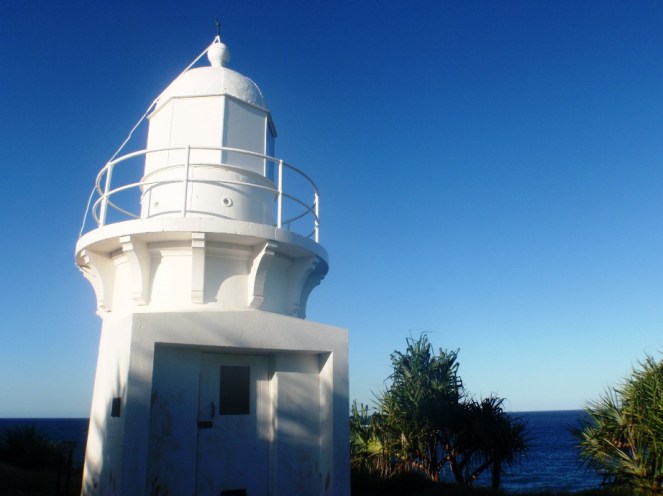
The lighthouse sits so peacefully, overlooking the ocean. I wanted to take photos from every angle possible.

One such lighthouse exists at Fingal Head, a lovely little seaside village just south of the New South Wales and Queensland borders.

The beacon flashes every five seconds and has a range out to sea of between 14 and 17 nautical miles.

This tiny lighthouse, situated twenty-four metres above sea-level, stands only seven metres in height, making it one of the smallest lighthouses in Australia. But height wasn’t an important factor when designing and building the lighthouse in 1878, due to the natural elevation of the site.

Once upon a time this lighthouse did have a keeper, in fact the first keeper, William Arnold, happily resided in the keeper’s residence with his wife and eleven children for twenty-seven years. What a view they enjoyed, with Cook Island just half a kilometre out to sea, and the endless blue waters of the Pacific Ocean, as far as the eye can see!

Cook Island, just half a kilometre from the headland.

These days, Fingal lighthouse has the honour of being the oldest public building in the Tweed Shire. It was converted to automatic operation in 1920 and with the keeper’s cottage having no further use, it was demolished.

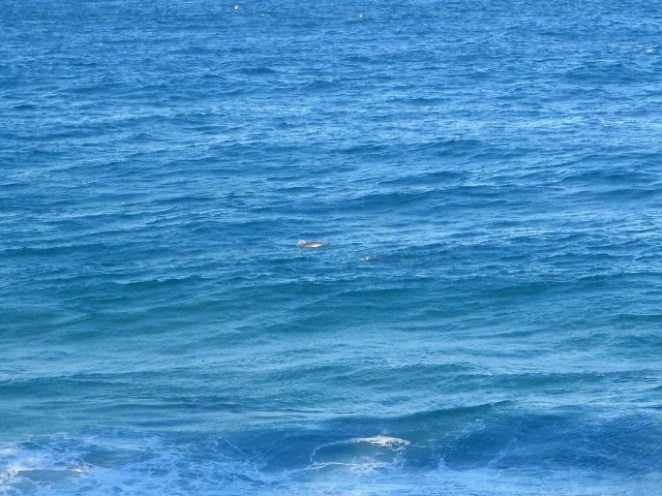
Yesterday, when I visited Fingal Heads, the sky was the most brilliant of blues and a pod of dolphins frolicked playfully not far from the shore. I wonder if Captain James Cook was met by such a delightful day, back in 1770, when he sailed north along the eastern coast of New South Wales, sighting Fingal Head and Cook Island, and naming the local landmarks of Point Danger and Mount Warning?

Looking down the rocks just beyond the lighthouse we saw a group of fishermen.

If there were any ghosts present at Fingal lighthouse yesterday, they were no doubt basking in the glory of the day, watching the dolphins play in the ocean below and sighing with contentment at the sight of the multitudes of happy people, enjoying a day in the sun in the surrounds of the old lighthouse.

Look carefully in the centre of the photo, you will see some dolphins in the water.

And what became of the scary ghost in my children’s beloved childhood story? The child in the story yelled “BOO!” to the ghost, and it fled down the one-hundred stairs, never to be seen again. 🙂

One contented Fingal resident. 🙂


challenges · summer

Weekly Photo Challenge ~ Curiosity

Where do these stairs and pathways lead to?

This week’s WordPress photo challenge theme is “curiosity” and what a powerful word that is!

Curiosity can to lead to many a new adventure; it opens up avenues for learning new things and can lead to many new and formerly unexplored paths.

The photo I have chosen to feature today shows pathways and stairs which I have yet to explore. They only became known to me after I came home one day with a series of photos I had taken at Point Danger last month, and I spotted this little nook as I looked through the photos on the computer.

I’m curious as to where the paths will lead and how the ocean will photograph at close range, with the waves breaking around the rocks.

When the heat-haze has cleared up a bit, hopefully during next week, my trusty little camera and I will be finding and exploring the site I have zoomed in on by editing the photo on the computer.

Because, well…I’m just plain curious! 🙂